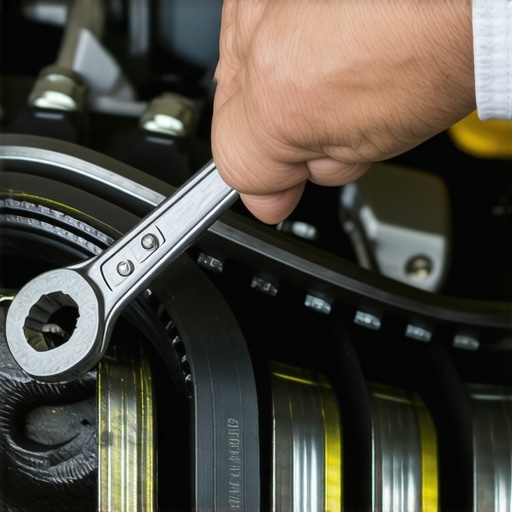
The Mechanical Reality Behind Serpentine Belt Noise
In the world of professional auto repair, a squeaking belt is rarely just a noise; it is a critical diagnostic signal indicating a failure in the accessory drive system’s harmony. Relying on aerosol belt dressings is a tactical error often made by novices. These sprays provide a temporary surge in the coefficient of friction by coating the belt in a tacky substance, but they ultimately attract road grit and dust, which act as abrasives against the pulleys. To perform a high-quality diagnostic on common auto problems, one must understand that modern EPDM (Ethylene Propylene Diene Monomer) belts do not crack like old neoprene belts; instead, they lose material in the grooves, much like a tire loses tread. This loss of material leads to ‘hydroplaning’ on the pulley during high-torque demands or damp conditions, causing that piercing chirp.
Stop Masking the Symptom with Chemical Treatments
Aerosol dressings often contain petroleum distillates that can actually accelerate the degradation of the belt’s internal structure. If you are serious about car longevity, you must address the physical interface between the belt and the pulley. An expert mechanic focuses on the three pillars of belt health: cleanliness, alignment, and tension. Before replacing parts, use a stiff wire brush to clean the pulley grooves while the engine is off. Removing accumulated rubber dust and debris can often restore the belt’s grip without a single drop of chemical spray. This procedure is a hallmark of essential tune-up tips that maintain peak engine performance.
The Two-Minute Water Test for Instant Diagnosis
To differentiate between a dirty belt and a mechanical misalignment, use a spray bottle filled with plain water. With the engine idling, lightly spritz the ribbed side of the belt. If the noise vanishes instantly only to return as the water evaporates, the belt is likely glazed or dirty. However, if the noise becomes louder or remains unchanged, you are likely dealing with a pulley that is out of parallel. According to technical documentation from Gates Corporation, misalignment as small as one degree can cause significant noise and premature belt failure. Identifying this early is key to preventing a costly auto repair later.
Target the Tensioner and Pulley Bearings
A common source of noise that spray can never fix is a weakening automatic tensioner. Over thousands of miles, the internal spring or damping mechanism wears out, allowing the belt to vibrate or ‘flutter.’ Watch the tensioner arm while the engine is running; if it is oscillating excessively, the belt will never stay quiet. Replacing a weak tensioner is an investment that protects the alternator and water pump bearings from uneven loads. This is a proactive step often included in tune-up strategies to save money by avoiding secondary failures.
Does a Squeak Always Mean the Belt Is Failing?
Not necessarily. In some professional scenarios, the noise originates from ‘bearing growl’ within an idler pulley or an alternator that mimics a belt squeal. To verify this, remove the belt and spin each pulley by hand. They should spin smoothly with a slight resistance and no audible grit or play. If a pulley spins too freely—like a fidget spinner—the internal grease has likely dried out, and the bearing is nearing the end of its service life. Explore our deep-dive into expert tune-up tips to master the art of component testing before you start buying parts.
Look Closely at the Harmonic Balancer for Hidden Failure
Beyond the pulleys and tensioners, the crankshaft pulley—often called the harmonic balancer—serves as the primary driver for the entire system. This component is essentially two concentric metal rings bonded together by a thick rubber isolator. Over time, heat cycles and engine vibrations can cause this rubber to degrade and lose its bond. When the outer ring begins to slip independently of the inner hub, it creates a subtle misalignment that is nearly impossible to spot at idle. This misalignment places lateral stress on the belt ribs, leading to a persistent chirp that defies standard replacements. As a professional mechanic tip for diagnosing auto problems, always mark a line across the face of the balancer with a paint pen. If the marks no longer line up after a test drive, the balancer is failing internally and must be replaced to prevent the belt from being thrown off entirely.
Why a Dying Battery Forces Your Belt to Scream
It is a common misconception that belt noise is purely a physical wear issue; often, it is an electrical load issue in disguise. When a battery is near the end of its life or has a dead cell, it demands a massive current from the alternator to maintain system voltage. This high electrical demand increases the magnetic resistance within the alternator, making it significantly harder for the belt to turn the pulley. This increased torque requirement often explains why your car still stumbles on cold starts and emits a sharp squeal during the first few minutes of operation. Before assuming the belt is stretched, use a multimeter to check your charging system. If the alternator is struggling to overcome a weak battery, the resulting drag will cause even a brand-new belt to slip across the alternator pulley.
Can an Internal Engine Vacuum Leak Masquerade as a Belt Chirp?
In some of the most perplexing cases, what sounds like a mechanical squeak from the drive system is actually an air-based anomaly. A failing PCV valve or a hairline crack in an intake manifold gasket can create a high-frequency whistle that perfectly mimics a dry pulley bearing. This phenomenon occurs because the rushing air vibrates the edges of the leak, creating a siren effect. To rule this out before dismantling your accessory drive, try how to find an intake leak using a 5 dollar bottle of soapy water. Sprinkling water around the intake area while the engine is running will temporarily seal the gap or change the pitch of the noise, confirming that you are dealing with a 5 dollar air leak rather than a mechanical failure.
Combat Fluid Contamination at the Source
Even the highest quality EPDM belts cannot survive constant exposure to engine fluids. Oil leaks from a front main seal or coolant weeping from a water pump weep hole will saturate the belt, causing the rubber to swell and lose its structural integrity. According to technical research from SAE International, petroleum-based contaminants drastically lower the friction coefficient of drive belts, leading to heat buildup that glazes the pulley surfaces. Once a pulley is glazed, it becomes as smooth as glass, losing the ‘bite’ required to grip the belt grooves. Cleaning these surfaces with a dedicated brake cleaner is essential, but the noise will return unless the underlying leak is addressed. Have you ever encountered a noise that vanished only to return after a rainy day? Share your weirdest diagnostic wins in the comments below, or suggest which engine system we should dive into next.
Sharpened Pulley Grooves Act Like Teeth on Rubber
While most technicians focus exclusively on the belt’s condition, the physical state of the pulley ribs is often the true culprit behind recurring noise. Over hundreds of thousands of revolutions, the ‘peaks’ of the metal or plastic pulleys can become sharpened through a process of abrasive wear. Instead of the belt sitting firmly in the valley of the groove, a worn-down pulley allows the belt to ‘bottom out.’ This lack of wedging action reduces the contact surface area, leading to high-frequency vibration and heat. If you notice a shiny, polished appearance at the very bottom of the pulley grooves, the component has reached its service limit. To ensure a professional-grade diagnostic on common auto problems, use a profile gauge to check for groove widening. Replacing a belt on a set of ‘knife-edged’ pulleys is a wasted effort, as the new rubber will be shredded or glazed within weeks.
Stop Cranking the Tensioner Bolt to Death
In older vehicles equipped with manual tensioning bolts, there is a dangerous temptation to solve every chirp by adding more tension. This is a fundamental error that leads to catastrophic component failure. Modern accessory bearings in your alternator, power steering pump, and A/C compressor are engineered for specific radial loads. When you over-tighten a belt to silence a noise, you are exerting excessive leverage on these internal bearings. According to technical bulletins from SKF Bearing Group, over-tensioning can reduce the service life of an alternator bearing by as much as 70% due to increased frictional heat and grease degradation. This is why a proper tune-up involves using a sonic tension meter or a mechanical deflection gauge rather than relying on ‘thumb pressure’ alone.
Can a Bent Mounting Bracket Cause a Permanent Belt Squeak?
Absolutely. In many high-mileage engines, or those that have undergone significant front-end repairs, the brackets that hold the alternator or power steering pump can become slightly distorted. Even a hairline fracture or a mounting bolt that has backed out by a fraction of a millimeter can tilt the pulley out of alignment with the rest of the drive train. This creates ‘edge wear,’ where the side of the belt rubs against the pulley flange. This mechanical interference produces a rhythmic chirping that often changes pitch with engine RPM but never fully disappears, even with a brand-new belt. Professionals use a laser alignment tool to project a beam across the pulley faces; if the laser doesn’t hit the center of the target pulley, the bracket must be shimmed or replaced. This level of precision is what separates a backyard fix from a high-quality auto repair.
Why Your Belt Only Screams on Frosty Mornings
The physics of EPDM rubber changes significantly with temperature. In sub-freezing conditions, the belt material becomes stiff and loses its natural elasticity, making it difficult for the ribs to seat properly into the pulleys during the first few rotations. As the engine warms up, the rubber becomes more compliant and the noise fades. However, if this ‘cold chirp’ persists for more than three minutes, it indicates that the belt has lost its chemical plasticizers—the agents that keep the rubber supple. This is a prime example of why your car still stumbles on cold starts with annoying auditory signals. For those looking to master tune-up strategies to save money, replacing the belt at the first sign of chronic cold-start noise can prevent a snapped belt from leaving you stranded in the winter. We are currently analyzing how different rib profiles—such as the ‘stretch-fit’ technology found in late-model European cars—affect these thermal expansion cycles.
Identify the Hidden Clutch Hiding on Your Alternator
The evolution of engine efficiency has introduced components that even seasoned technicians occasionally overlook, specifically the Overrunning Alternator Pulley (OAP) and the Overrunning Alternator Decoupler (OAD). Unlike a solid pulley, these units contain an internal one-way clutch mechanism designed to ‘decouple’ the alternator’s heavy internal rotor from the engine’s rotational vibrations. When this clutch seizes, it no longer dampens the torsional spikes of the crankshaft, forcing the belt to absorb the energy. This results in a violent belt flutter and a low-frequency growl or chirp that mimics a failing tensioner. If you find yourself performing a tune up and notice the tensioner arm bouncing aggressively at idle, the culprit is likely the OAD rather than the tensioner itself.
Why Does Your Belt Thrash Violently During Rapid Deceleration?
This phenomenon is a textbook symptom of a failed alternator decoupler. As the engine RPM drops quickly, the alternator’s inertia wants to keep it spinning at the previous high speed. A functional OAD allows the alternator to ‘freewheel’ forward, but a seized one locks the system together, forcing the belt to slip across the pulley and emit a sharp scream. According to technical bulletins from Continental Aftermarket, neglecting a failed OAD will eventually lead to the belt snapping or, in extreme cases, the alternator shaft shearing off entirely. Verifying this requires a specialized splined tool to check if the pulley can spin freely in one direction but lock in the other—a step every professional should include in a comprehensive auto repair plan.
Stop Prying at Stretch-Fit Belts with a Screwdriver
Modern automotive engineering has increasingly favored ‘stretch-fit’ or elastic belts for secondary drives, such as the A/C compressor or power steering pump. These belts lack a traditional tensioner, relying instead on high-tensile elastic cords within the belt structure to maintain grip. A frequent error during tune-up strategies involves trying to ‘walk’ these belts onto the pulley using a pry bar or screwdriver. This practice is catastrophic; it creates microscopic tears in the internal cords, leading to a belt that stretches unevenly and begins to squeal within days. You must use a dedicated installation tool that wraps around the pulley to guide the belt smoothly into the grooves without over-stressing the rubber. This precision ensures your diagnostic on common auto problems leads to a permanent fix rather than a repeat failure.
Spot the Ghost Squeal Caused by Excessive Pulley Runout
Even with perfect tension and a fresh belt, a persistent noise can persist if a pulley is ‘out of round’ or has excessive lateral runout. If a pulley was previously dropped or struck during a different service, it may have developed a slight wobble. As the pulley rotates, this wobble forces the belt to move side-to-side across the other pulleys in the system. This creates a rhythmic ‘chirp-chirp-chirp’ that correlates exactly with engine speed. Professionals use a dial indicator to measure the runout on the pulley face; anything exceeding 0.5mm is often enough to cause audible interference. Addressing this level of detail is what separates a master mechanic from an amateur. Is your front-end noise defying every standard fix? Drop a comment with your vehicle’s make and model, and let’s troubleshoot the specifics of your accessory drive layout together.
Expert Insights & Advanced Considerations
Stop Ignoring Torsional Stress from the Crankshaft
Modern high-compression engines generate intense harmonic vibrations that a standard belt cannot dampen alone. In these setups, the belt functions as a sacrificial dampener for the entire accessory drive. If you are noticing repeated failures, the issue is likely a mismatch between the belt’s modulus of elasticity and the crankshaft’s torsional spikes. This is why a professional diagnostic on common auto problems must evaluate the harmonic balancer as much as the belt itself.
Find Hidden Friction with a Thermal Imaging Camera
Sound is a late-stage symptom of mechanical failure. To catch issues before they scream, use a thermal imaging camera after a ten-minute drive. A pulley bearing that is 15-20 degrees Celsius hotter than its counterparts is experiencing internal drag or grease starvation. Integrating this into your essential tune-up tips allows for predictive maintenance, replacing a cheap idler pulley before it seizes and snaps an expensive belt.
Why Your Choice of Cleaner Dictates Belt Longevity
Using aggressive brake cleaner or harsh degreasers on the belt itself is a recipe for chemical hardening. If you must clean the system, use only mild soap or dedicated EPDM-safe cleaners on the metal pulleys. Contamination from oil or coolant is the primary killer of belt grip, and addressing these leaks is a core part of auto repair that many DIYers overlook. Keeping the friction interface dry and debris-free is the only way to ensure long-term silence.
#IMAGE_PLACEHOLDER_E#
Curated Expert Resources
Gates Technical Training: This is the gold standard for understanding belt wear patterns. Their documentation on EPDM material loss versus traditional neoprene cracking is essential for any mechanic looking to sharpen their diagnostic skills.
ASE Certification Standards: Reviewing the A1 and A8 test prep materials provides a structured approach to drive system diagnostics, moving beyond guesswork and into systematic testing.
SAE International Technical Papers: For those who want to understand the physics of rib-jump and the resonant frequencies of serpentine systems, these papers offer peer-reviewed data on belt dynamics under high electrical loads.
The Final Verdict on Drive System Harmony
Successfully silencing persistent serpentine belt noise requires moving past the superficial and into the mechanical heart of the engine. Whether it is a failing alternator decoupler, a subtle pulley misalignment, or an electrical load issue causing why your car still stumbles on cold starts, the solution is always found in precision measurements rather than aerosol cans. By applying these tune-up strategies to save money, you protect the longevity of your alternator, water pump, and power steering system. If you have encountered a belt chirp that defied all logic, or have a specific ghost squeak you are currently fighting, leave a comment below—let us break down the technical data together.