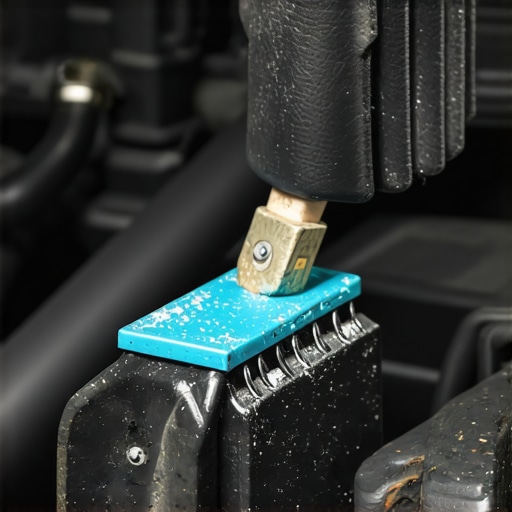
Electrical Resistance Is the Hidden Killer of Modern Starters
In the realm of professional auto repair, we often see technicians jump to replace an alternator or a starter motor without first assessing the most basic element of the circuit: the interface between the battery post and the terminal. A microscopic layer of lead sulfate or copper oxidation creates significant voltage drop, forcing the starter to draw more current to compensate, which eventually burns out the solenoid. This isn’t just a maintenance chore; it is a critical tune up for your electrical system that can prevent a costly visit to a mechanic for a premature component failure.
Is your mechanic overlooking the simplest fix for a slow crank?
Many drivers assume a slow engine turnover indicates a dying battery, but professional diagnostics often reveal that the battery’s state of charge is healthy while the delivery system is compromised. High-resistance connections generate heat and prevent the full amperage from reaching the ignition system. Before you commit to a major brake service or complex engine work, ensuring your power source is stable is paramount. You should check this ground connection first to rule out simple wiring faults that mimic terminal corrosion. According to technical standards from the Society of Automotive Engineers (SAE), maintaining clean electrical contact points is essential for the longevity of sensitive onboard computers and sensor arrays.
The Five-Minute Restoration Protocol
To execute a professional-grade terminal clean, start by disconnecting the negative cable to prevent accidental shorting. Use a dedicated terminal brush to scour both the post and the inner ring of the cable end until the metal shines with a bright, silvery luster. A solution of baking soda and water can neutralize acidic buildup, but it must be kept away from the battery vents. This simple procedure is a cornerstone of essential auto repair practices that keep high-mileage vehicles reliable. Once clean, applying a thin layer of dielectric grease or a specialized terminal protector spray will seal the connection from moisture and oxygen, effectively halting the oxidation process for several months.
Why Clean Terminals Matter for More Than Just Starting
Modern vehicles rely on steady voltage for everything from transmission shift points to the anti-lock sensors checked during a standard brake service. Irregular voltage spikes or dips caused by poor battery contact can trigger ‘ghost’ trouble codes in the ECU. If you are performing a tune up, ignoring the battery terminals is like trying to run a marathon while breathing through a straw. It doesn’t matter how well the engine is calibrated if the spark energy is inconsistent. We have documented cases where cleaning a single ground bolt resolved mystery misfires that baffled other shops. For more advanced troubleshooting, see our mechanic tips for diagnosing common auto problems to see how electrical health correlates with mechanical performance. If you have experienced a dramatic improvement after a simple terminal clean, share your results with our community of enthusiasts to help others avoid unnecessary component replacements.
Modern Sensors Hate Fluctuating Amperage
When the connection at your battery terminals begins to degrade, it does more than just hinder the starter. Modern vehicles operate on a complex Controller Area Network (CAN bus) where modules communicate through millivolt signals. High resistance at the battery creates ‘dirty’ power, introducing electrical noise that can confuse delicate components. This often manifests as a rough idle or erratic transmission behavior that a standard tune up might not solve. If your car feels like it is struggling to find the right gear, you might be looking for a transmission shift fix when the real culprit is a simple lack of consistent voltage to the TCM (Transmission Control Module).
Could your dashboard warning lights be lying to you?
Ghost codes are the bane of every modern mechanic. These are diagnostic trouble codes (DTCs) that trigger a Check Engine Light despite the physical sensors being perfectly functional. When voltage drops below a specific threshold—usually around 10.5 volts during cranking—the ECU may reset or lose its ‘learned’ fuel trim data. This leads to a vehicle that stumbles or stalls immediately after starting. Before you replace an expensive oxygen sensor or mass airflow sensor, remember that cleaning a simple sensor connector or tightening a battery terminal often clears the fault permanently. Experts at the National Institute for Automotive Service Excellence (ASE) emphasize that electrical verification must always precede component replacement to avoid the ‘parts cannon’ approach to auto repair.
Master the Voltage Drop Test to Stop Part-Swapping
Static voltage readings—checking a battery while the car is off—only tell half the story. To truly understand if your terminals are performing, you need to perform a voltage drop test under load. By placing a multimeter lead on the battery post and the other on the cable terminal while an assistant cranks the engine, you can see exactly how many volts are being lost to resistance. Anything over 0.2 volts suggests your cleaning wasn’t thorough enough. This level of precision is what separates a professional brake service or engine diagnostic from a backyard guess. Identifying these leaks in your electrical path is often the move that fixes dim headlights and sluggish power windows simultaneously.
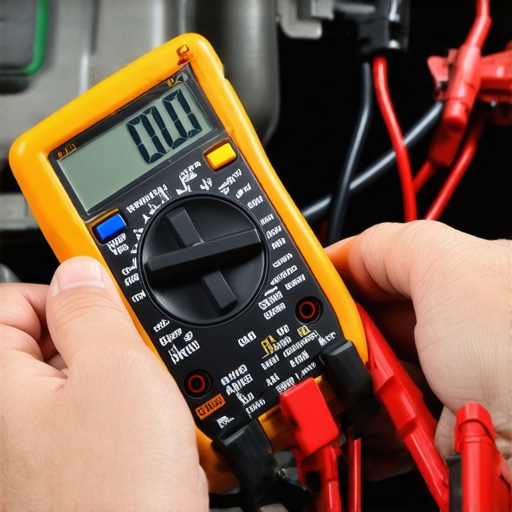
Beyond the terminals themselves, the secondary ground wires that attach to the vehicle’s chassis or engine block are equally critical. These smaller wires often corrode from the inside out, hidden by their plastic sheathing. If you have already cleaned your main terminals but still experience intermittent power loss, you should test your alternator and ground path using basic hand tools. Ensuring a clear path for current to return to the battery is the final step in a comprehensive electrical tune up. Have you ever spent hundreds on a new alternator only to find the problem persisted? Tell us about your diagnostic wins or frustrations in the comments below, as your experience might save a fellow driver from a similar headache.
Why Temperature Fluctuations Aggravate Poor Connections
Thermal expansion and contraction are the enemies of a tight electrical fit. As your engine bay heats up during a long drive, the different metals in your battery posts (lead) and terminals (usually copper or lead-alloy) expand at different rates. A connection that seems tight while cold can become loose or high-resistance once the vehicle reaches operating temperature. This is why some drivers notice their car starts fine in the morning but struggles after a quick stop at the grocery store. This heat-soak phenomenon is a frequent topic during a deep-dive brake service or cooling system inspection, where technicians must ensure that heat-shielding is intact to protect electrical looms. By maintaining a pristine, greased connection, you provide the necessary conductivity to overcome these physical changes, ensuring your auto repair efforts actually last through the changing seasons.
Don’t Let Your Intelligent Battery Sensor Misread the Situation
In the latest generation of vehicles, the mechanic often encounters a small, square module attached directly to the negative battery terminal. This is the Intelligent Battery Sensor (IBS) or Battery Monitoring System (BMS). Its job is to report the state of charge, current flow, and internal temperature back to the Engine Control Unit (ECU). If your terminal cleaning process involves removing this sensor, you must ensure the contact surfaces are surgically clean. Even a minor increase in resistance here can cause the ECU to believe the battery is aging prematurely, leading the alternator to pump out excessive voltage. This overcharging doesn’t just shorten the life of your battery; it puts unnecessary strain on every bulb and motor in the car, turning a routine tune up into a diagnostic nightmare.
Can a loose battery cable fry my car’s computer?
While a total disconnect usually just results in a dead car, an intermittent connection—one that flickers on and off due to vibration—is far more dangerous. This creates a phenomenon known as ‘load dumping.’ When the connection to the battery is lost while the alternator is spinning, the voltage can spike to over 60 volts for a fraction of a second. According to technical documentation from the Battery Council International (BCI), these transient surges are the primary cause of fried logic gates in modern control modules. This is why ensuring your terminals are torqued to the correct spec is as vital as any brake service you perform; it is the primary surge protector for your vehicle’s brain. If you’ve ever had a radio suddenly reset or your dashboard lights flicker, you are likely experiencing these micro-spikes right now.
Stop Corrosion Before It Starts with Synthetic Sealants
Most DIY enthusiasts stop once they see the metal shine, but that is only half the battle. Raw lead and copper are highly reactive. To prevent the inevitable return of blue-green fuzz, you need a chemical barrier that won’t interfere with the flow of electrons. While old-school petroleum jelly works in a pinch, professional-grade auto repair shops utilize synthetic terminal protectors or specialized anaerobic sealants. These products are designed to migrate into the microscopic gaps between the post and the terminal, displacing oxygen and moisture. This is especially critical for vehicles parked in coastal areas or regions where road salt is prevalent. Think of this step as the ‘sealant’ phase of a tune up, providing a layer of armor that maintains your electrical integrity for years rather than months.

When applying these protectors, the ‘less is more’ rule applies. You want the metal-to-metal contact to remain tight, with the sealant forming a perimeter around the junction. If you are noticing that your headlights dim every time the cooling fan kicks on, it’s a sign that your current protective layer has failed and resistance is climbing. Have you ever wondered if your car’s electrical quirks are actually just a sign of a ‘tired’ ground? You might want to try this simple ground wire move to see an immediate difference in your night driving visibility. Identifying these small bottlenecks is the hallmark of a truly skilled enthusiast.
Why Your High-End Sound System Demands a Perfect Ground
For those who have invested in aftermarket audio or high-performance lighting, the standard factory terminals are often the weakest link in the chain. These systems pull high-frequency current that can be choked by even the slightest oxidation. This is where the ‘Big Three’ upgrade comes into play—replacing the factory alternator-to-battery, battery-to-chassis, and engine-block-to-chassis wires with heavy-gauge oxygen-free copper. This isn’t just for show; it reduces the total impedance of the system, allowing for faster transient response. Whether you are prepping for a brake service that includes electronic parking brake calibration or just want your bass to hit harder, the quality of your terminal interface dictates the ceiling of your car’s performance. Consider how much energy is being wasted as heat at a hot terminal right now.
The ADAS Sensitivity Trap: Why Your Safety Tech Needs Pristine Power
As we move deeper into the era of semi-autonomous driving, the margin for electrical error has shrunk to nearly zero. Components like Radar sensors, LiDAR, and high-definition cameras used in Lane Keep Assist and Adaptive Cruise Control are extraordinarily sensitive to voltage ripple. If your battery terminals have even a slight film of oxidation, the fluctuating resistance can cause these safety systems to disengage without warning. During a comprehensive tune up, a savvy mechanic knows that recalibrating a camera is useless if the underlying power delivery is unstable. These safety modules communicate via high-speed data protocols that interpret minor voltage sags as hardware failures, often leading to expensive and unnecessary module replacements. Ensuring a rock-solid connection is no longer just about starting the car; it is about maintaining the integrity of the vehicle’s electronic safety net.
Can a dirty battery post actually cause your transmission to slip?
It sounds far-fetched to many drivers, but the answer is a resounding yes. Modern electronically controlled transmissions rely on solenoids that must fire with millisecond precision. When terminal corrosion introduces resistance, the Transmission Control Module (TCM) may receive inconsistent data from speed sensors, leading to ‘hunting’ between gears or harsh shifts. This is frequently misdiagnosed as a mechanical failure requiring a brake service style teardown or a full transmission flush. In reality, the solenoid simply wasn’t receiving the peak amperage required to move the shift valve cleanly. High-level technical research from IEEE (Institute of Electrical and Electronics Engineers) confirms that signal-to-noise ratios in automotive networks are directly compromised by poor grounding and high-impedance battery interfaces.
How Electrolysis Turns Your Battery Terminals Into a Chemistry Experiment
In humid or coastal environments, the process of electrolysis accelerates at an alarming rate. When two dissimilar metals—like the lead of the battery post and the copper of a high-performance terminal—are joined in the presence of an electrolyte (moisture and road salt), they create a tiny galvanic cell. This doesn’t just create surface ‘fuzz’; it causes ‘crevice corrosion’ that eats into the strands of the battery cable itself. This is why a simple auto repair of cleaning the surface often fails to fix the problem long-term. Professional technicians often use a specialized penetrating cleaner that wicks into the cable strands to neutralize this hidden decay.  Ignoring this chemical reality during your annual tune up is essentially allowing your car’s wiring to be consumed from the inside out.
Silver and Tin: The Material Science of Modern Connector Integrity
While older vehicles used simple lead clamps, many premium modern brands have switched to tin-plated or even silver-plated connectors to handle the increased current demands of start-stop technology. These coatings are incredibly thin and can be easily destroyed by aggressive wire-brushing or the use of harsh abrasive tools. A professional mechanic must use specialized non-marring cleaning pads to preserve these layers. Once the plating is gone, the base metal oxidizes almost instantly, leading to a cycle of recurring electrical gremlins that can baffle even the best shops. If you find yourself frequently dealing with a rough idle or dimming lights, take a close look at the color of your terminals; if the silver or tin plating is worn down to the copper, it’s time to stop cleaning and start replacing. Have you checked the physical condition of your terminal plating lately? Share your findings with us in the comments, and let’s discuss the best replacement options for your specific make and model.
Expert Insights & Advanced Considerations
Voltage drop is your only honest metric
Don’t trust a static multimeter reading of 12.6V. The true health of your connection is revealed only under the massive load of a starter motor. A professional mechanic knows that even a connection that looks clean can hide high impedance. Performing a ground connection check while cranking is the only way to expose high-resistance bottlenecks that cause phantom sensor codes.
Thermal runaway starts at the post
High resistance generates heat. In high-amperage environments, a loose terminal can become a heating element, melting the battery casing or the lead post itself. This heat-soak effect can drastically alter the internal resistance of the battery, leading the charging system to overcompensate. This is why a proper tune up of the electrical system is as critical as any mechanical adjustment.
The hidden cost of generic terminal shims
Using lead shims to ‘tighten’ a stretched terminal is a temporary fix that introduces a third metal into the galvanic equation. This creates more surface area for oxidation to hide. If your terminal doesn’t bite the post firmly, it’s a sign that the metal has lost its spring tension. Replacing the terminal end entirely is an essential auto repair step that prevents future roadside failures.
#IMAGE_PLACEHOLDER_E#
Curated Expert Resources
SAE International Technical Standards
The Society of Automotive Engineers provides the foundational research on electrical contact integrity and terminal crimp specifications. Their standards are the benchmark for every OEM wire harness design.
BCI (Battery Council International) Guides
For a deep dive into lead-acid and AGM chemistry, the BCI technical manuals offer peer-reviewed data on how terminal corrosion impacts the chemical lifespan of modern batteries.
ASE Advanced Engine Performance Manuals
These resources focus on the intersection of electrical health and computer logic, providing mechanic tips for diagnosing common auto problems that stem from unstable voltage sources.
Final Expert Perspective
At the end of the day, your vehicle’s complex electronic ecosystem is only as reliable as its primary power interface. We often see high-dollar components replaced when a simple fifteen-minute restoration of the battery terminals would have sufficed. Viewing terminal maintenance as a core component of your tune up strategy protects your sensors, your transmission, and your peace of mind. For more ways to optimize your vehicle’s performance without overspending, explore our auto repair cost-saving tips from industry experts. Do you have a story of a ‘dead’ car that was saved by a wire brush? Join the conversation and share your technical wins with our community of pros.