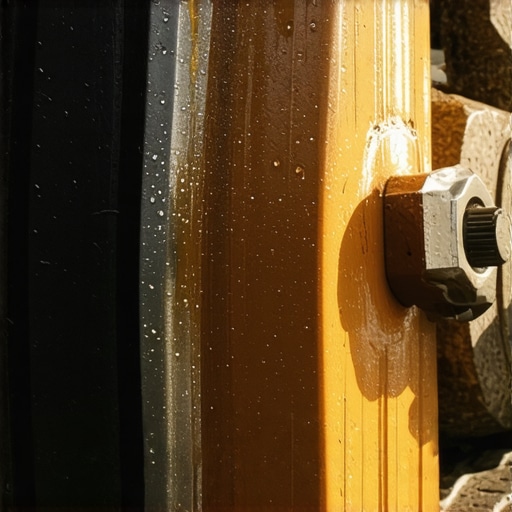
How Overnight Oxidation Creates That Temporary Grinding Sound
For most drivers, the initial brake application of a damp morning produces a distinct rasping or grinding sound that seems to vanish by the second stop. While this phenomenon is often benign, an expert mechanic recognizes it as the mechanical shedding of flash rust—a thin layer of oxidation that forms on cast-iron rotors in humid environments. Because rotors are exposed to the elements, moisture in the air reacts with the carbon and iron in the rotor surface, creating a microscopic layer of iron oxide. The first time the pads clamp down, they essentially act as a lathe, scraping away this oxidation to reveal fresh metal. If the noise persists beyond the first few blocks, it may indicate a need for professional brake service. High-performance semi-metallic pads are particularly prone to this audible oxidation because they contain steel fibers that react quickly with moisture, whereas ceramic pads tend to be quieter but may still experience some surface friction variation when cold.
[image_placeholder]
Could Humidity Be Hiding a More Serious Mechanical Failure?
Often, drivers ignore persistent grinding because they assume it is simply the weather. However, what starts as a “morning rasp” can sometimes mask deeper issues with the braking assembly. For instance, if the grinding is accompanied by a slight pulsation or a tugging sensation, it might not be rust at all, but rather the onset of uneven pad wear. As noted by the Society of Automotive Engineers (SAE), brake noise (NVH) is a complex interaction of frequency and friction coefficients that can be influenced by atmospheric pressure and ambient temperature. If you notice the sound remains constant even after several minutes of driving, it is vital to consult a specialist in brake service strategies to ensure your calipers are not sticking. A stuck caliper prevents the pad from retracting fully, leading to constant metal-on-metal contact that can warp your rotors in a matter of weeks.
Why Cold Friction Coefficients Differ from Operational Norms
Addressing brake noise is a critical component of any comprehensive auto repair strategy. When diagnosing these issues, professionals look beyond the pads and rotors to the hydraulic health of the vehicle. A routine tune up should involve more than just spark plugs; it must include a comprehensive visual inspection of the braking hardware and fluid condition. In addition to oxidation, the hygroscopic nature of brake fluid can occasionally contribute to a soft pedal during those first few stops, as moisture that has permeated the rubber lines pools near the calipers. This is why a periodic tune up including a fluid flush is paramount. A common oversight is the lubrication of the caliper guides. As discussed in our analysis of the brake slide pin error, a lack of specialized high-temperature grease can cause pads to drag, leading to glaze and reduced stopping power. If your vehicle’s morning voice sounds more like a permanent scream, don’t wait for a breakdown—contact our expert team today to schedule a thorough safety inspection.
How Frayed Control Arm Bushings Trick You Into Thinking Your Brakes Are Shot
Many drivers mistakenly attribute steering wheel feedback or uneven stopping to the braking system itself, when the culprit often lies deeper in the chassis. When you apply the brakes, the weight of the vehicle shifts forward, putting immense pressure on the front suspension components. If your control arm bushings are cracked or excessively soft, they allow the suspension geometry to shift under load, which can manifest as a sensation very similar to a sticking caliper or a bad rotor. This is a common point of confusion for DIY enthusiasts, leading them to replace expensive hydraulic parts when a simple set of bushings would suffice. If you find that your car darts to the left when you hit the brakes, it is rarely a brake fluid issue and almost always a sign that a suspension mount has failed. A professional mechanic knows how to isolate these variables by performing a pry-bar test on the bushings while the vehicle is lifted, ensuring you aren’t throwing money at symptoms rather than causes.
Is Your Choice of Alloy Wheels Quietly Killing Your Stopping Distance?
The aesthetic appeal of heavy, multi-spoke alloy wheels often comes with a hidden performance tax: heat retention. Brakes convert kinetic energy into thermal energy, and that heat needs a quick exit. High-density wheel designs can act like a thermal blanket, trapping hot air around the rotors and preventing the cooling vents from doing their job. In humid or rainy conditions, this lack of airflow prevents the “flash rust” we discussed earlier from drying out quickly, potentially leading to deeper pitting on the rotor surface. According to data from the National Highway Traffic Safety Administration (NHTSA), brake-related issues are the leading mechanical cause of crashes, accounting for roughly 22% of vehicle-related accidents, many of which are exacerbated by component overheating. Choosing wheels with an open-spoke design not only reduces unsprung weight but significantly aids in the cooling process, keeping your friction coefficients stable even during spirited driving or heavy mountain descents.
The Myth of the Warped Rotor and the Transfer Layer Truth
One of the most persistent misunderstandings in auto repair is the concept of a “warped” rotor. In reality, modern cast-iron rotors rarely warp from heat alone; instead, what feels like a warp is actually uneven pad material deposition. If you come to a hard stop and keep your foot firmly on the brake pedal while the rotors are glowing hot, a small amount of friction material literally welds itself to the rotor face. This creates a high spot that causes the pedal to pulse the next time the pads pass over it. Learning how to stop your brakes from pulsing without buying new rotors often involves a process called “bedding in,” where you perform a series of controlled stops to distribute that transfer layer evenly. If the vibration persists, you might be dealing with brake rotors that fail after only 5000 miles due to poor installation or cheap metallurgy. By focusing on the secret to quiet brakes—which involves meticulously cleaning the hub surface before mounting the rotor—you can eliminate lateral runout before it starts. If you’ve noticed your steering wheel shaking when you apply the brakes, tell us about the symptoms in the comments—our community of enthusiasts and experts loves to troubleshoot these mechanical riddles and help you find the source of a mystery suspension clunk or braking vibration.
Why Your Rubber Brake Hoses Might Be Acting Like One-Way Valves
While most enthusiasts focus on the interaction between the pad and the rotor, the hydraulic conduit—the flexible rubber brake hose—is a common failure point that hides in plain sight. Over time, the internal lining of these hoses can delaminate due to intense heat cycles and atmospheric moisture ingress. This creates a microscopic flap of rubber that acts as a physical check valve; when you depress the pedal, the high pressure of the master cylinder forces fluid past the obstruction, but the relatively weak return spring pressure in the caliper cannot push it back. The result is a brake that drags, overheats, and destroys your brand new brake service investment within just a few miles. Upgrading to braided stainless steel lines isn’t just for race cars; it provides a permanent barrier against this internal swelling and offers a significantly more linear pedal response by eliminating hose expansion under heavy load.
Why Does My Brake Pedal Feel Spongy Only When It’s Hot?
This is a classic symptom of fluid boiling, often caused by the accumulation of water within the hygroscopic brake fluid. As fluid ages, its boiling point drops significantly because water turns to steam much faster than hydraulic oil. During a spirited drive or a long descent, the heat generated at the rotor transfers through the caliper piston and into the fluid. If that fluid contains even a small percentage of water, it can turn to steam at temperatures that fresh DOT 4 fluid would handle with ease. Unlike liquid, steam is compressible, leading to that terrifying floor-bound pedal sensation. To prevent this, a professional tune up must involve a copper strip test or an electronic refractometer reading to measure the moisture content precisely, ensuring your safety isn’t compromised by invisible chemical degradation.
The Silent Threat of Magnesium Chloride on Hydraulic Integrity
For those living in the ‘salt belt,’ the transition from traditional rock salt to liquid magnesium chloride for de-icing has introduced a new variable in the longevity of your braking system. While more effective at lower temperatures, magnesium chloride is more ‘stuck’ to surfaces and highly conductive, which accelerates galvanic corrosion where different metals meet—such as steel brake lines and brass fittings. According to a technical bulletin from the National Association of Corrosion Engineers (NACE), these modern de-icing chemicals can penetrate even the plastic coatings on newer brake lines, leading to localized pitting that can cause a sudden, catastrophic pressure loss. If you notice any dampness or ‘sweating’ around your chassis rails, it is a sign that the corrosion has moved beyond the surface. An expert mechanic will prioritize a thorough undercarriage wash and the application of a corrosion inhibitor to these vulnerable junctions during any seasonal inspection.
Regenerative Braking and the Paradox of the Idle Caliper
In the world of Electric Vehicles (EVs) and hybrids, the braking paradox is real: your pads might last 100,000 miles, but your calipers are more likely to seize than those on a heavy-duty truck. Because regenerative braking handles the vast majority of deceleration, the mechanical calipers rarely get the workout they need to stay limber. This lack of movement allows road grime and salt to settle into the piston seals, where it hardens and eventually prevents the piston from retracting. This leads to ‘phantom dragging,’ where one wheel is constantly under slight braking pressure, killing your range and causing uneven tire wear. If you drive a Tesla, Prius, or any electrified platform, a specialized auto repair check-up should include a manual cycling of the calipers to ensure the sliders haven’t petrified from disuse. Have you noticed a drop in your EV’s range lately? It might not be the battery—it could be a sticking pad that needs a bit of ‘old school’ lubrication.
Mastering the Dark Art of Electronic Parking Brake Service
Modern vehicles have replaced the satisfying click of a handbrake with a small button that activates an electric motor on the rear calipers. While convenient, the Electronic Parking Brake (EPB) has complicated the standard brake job for the DIYer and the unequipped shop alike. Attempting to compress a rear caliper piston without first putting the car into ‘Maintenance Mode’ or using a diagnostic scan tool can strip the internal gears of the motor, leading to a repair bill that dwarfs the cost of the pads themselves. This is where the intersection of tune up technology and mechanical skill becomes critical. A technician must use software to retract the actuator electronically before the mechanical work begins. Furthermore, many systems require a ‘calibration’ sequence after new pads are installed to ‘teach’ the computer the new thickness of the friction material, ensuring the clamping force remains within the manufacturer’s specified range for emergency scenarios. As we look closer at the integration of software and hardware…
Why a Dirty Hub Face Ruins Even the Best Brake Job
The precision of a modern brake assembly leaves zero margin for error at the hub-to-rotor interface. Even a few thousandths of an inch of rust or debris trapped on the hub flange can translate into significant lateral runout at the outer edge of the rotor. This microscopic misalignment is the hidden culprit behind pedal pulsation that many shops misdiagnose as warped metal. An expert mechanic knows that a successful installation begins with a pristine, silver-bright hub surface. Failing to clean this area leads to ‘induced runout,’ where the rotor wobbles as it spins, causing uneven contact with the pads and eventually creating thin and thick spots on the rotor surface. This is why a comprehensive brake service must include a thorough cleaning of the hub with a specialized abrasive tool to ensure a perfectly flat mating surface.
Does Your Mechanic Measure Lateral Runout with a Dial Indicator?
This is the litmus test for professional-grade service. While most shops simply ‘slap’ new rotors on, a true specialist uses a dial indicator to measure the runout after the rotor is torqued down. If the deviation exceeds the manufacturer’s tight tolerances—often as little as 0.002 inches—the technician must index the rotor to a different position on the hub or use specialized correction shims. This level of detail is what separates a standard auto repair from a high-performance restoration of factory-spec braking. Neglecting this measurement is the primary reason many drivers experience the return of steering wheel shake just a few months after paying for new parts.
Copper-Free Pads and Your Changing Expectations of Dust
The chemical composition of friction material is undergoing a massive shift due to environmental legislation like the California ‘Better Brakes Law.’ As highlighted by the California Department of Toxic Substances Control (DTSC), the phase-out of copper in brake pads is designed to protect aquatic life from runoff. However, for the driver, this means the ‘feel’ and dust characteristics of your pads are changing. Modern copper-free ceramic and semi-metallic formulations are engineered to provide the same stopping power, but they may exhibit different thermal recovery rates. During a routine tune up, it is vital to discuss which friction formula matches your driving style, as some eco-friendly pads produce a finer, more adhesive dust that requires specific wheel cleaning agents to prevent finish degradation.
Spotting the Difference Between a Failing Vacuum Booster and a Leaky Master Cylinder
When a driver complains of a ‘hard’ brake pedal, the diagnostic path diverges between hydraulic failure and vacuum assist issues. If the pedal feels like a block of wood and requires immense leg strength to stop the car, the vacuum booster—the large drum behind the master cylinder—has likely lost its internal diaphragm integrity or its vacuum supply. Conversely, if the pedal is firm at first but slowly sinks to the floor while stopped at a red light, the internal seals of the master cylinder are bypassing fluid. This is a critical distinction in diagnosing common auto problems; one involves a loss of power assistance, while the other indicates a catastrophic loss of hydraulic pressure. Neither should be ignored, as they represent the final stages of component life. If your pedal travel has changed even slightly, don’t guess—contact our diagnostic team today to perform a pressure test and ensure your safety remains uncompromised.
Expert Insights & Advanced Considerations
Why 0.002 Inches of Runout Ruins Everything
Precision is the difference between a quiet stop and a vibrating steering wheel. If your mechanic doesn’t clean the hub face to a mirror finish, you are inviting lateral runout. This isn’t just about the parts; it is about the geometry of the entire assembly. Even the most expensive ceramic pads will fail if the rotor isn’t perfectly indexed on the hub. Professional brake service strategies always prioritize this cleaning step to prevent premature component failure.
Stop Trusting Your Visual Brake Fluid Check
Fluid color is a secondary indicator; moisture content is the true killer. Professionals use refractometers to check for water absorption because hygroscopic fluid lowers the boiling point, causing that terrifying spongy pedal in traffic. A comprehensive tune up should always prioritize chemical testing over simple visual inspection to ensure hydraulic integrity under heavy heat cycles.
Keep Your EV Calipers from Turning into Paperweights
Regenerative braking is a miracle for pad life but a nightmare for caliper pistons. Without regular manual cycling, seals dry out and pistons seize from environmental exposure. Owners of electrified vehicles must realize that a proper brake service for them is more about mechanical lubrication and exercise than friction replacement. Neglecting this leads to dragging, which mimics the symptoms of common auto problems like bad wheel bearings.
[image_placeholder]
Curated Expert Resources
Society of Automotive Engineers (SAE) Technical Papers
For those who want to dive into the physics of NVH (Noise, Vibration, and Harshness), SAE offers deep-dive studies on friction coefficients and thermal dissipation that set the global standards for modern auto repair.
NHTSA Safety Research & Recalls
The primary source for tracking systemic failures in braking systems across specific makes and models, providing data-driven insights into component longevity and critical safety alerts for modern vehicles.
Brake & Front End Magazine
An essential trade publication for staying current with top auto repair trends and learning how to navigate the complexities of modern electronic braking systems and integrated safety software.
Mastering Your Machine’s Stopping Power
True automotive mastery requires looking past the simple symptoms to understand the interconnected nature of the chassis. Whether it is ensuring your next maintenance visit includes a dial indicator check or understanding how regular tune ups preserve the integrity of your hydraulic lines, being proactive is the only way to ensure safety. We invite you to share your complex diagnostic victories in the comments or reach out to our team if you are struggling with why your steering wheel shakes when you brake at high speeds. Let’s keep the conversation—and your vehicle—moving safely.