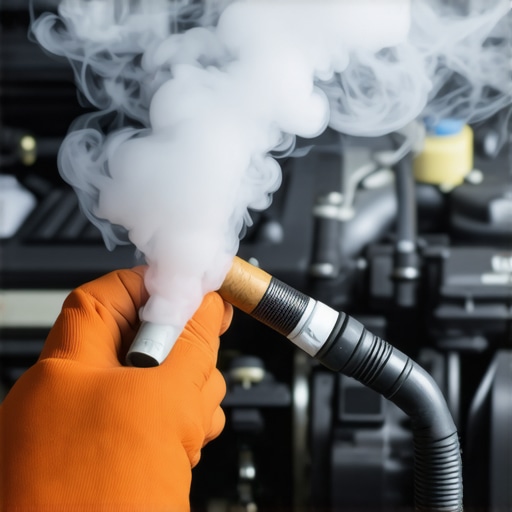
The delicate balance of the internal combustion engine relies on a precise air-to-fuel ratio, typically regulated near the stoichiometric 14.7:1 point. When a vacuum leak introduces unmetered air—atmospheric air entering the combustion chamber downstream of the Mass Air Flow sensor—it triggers a cascade of performance failures, ranging from surging idles to catastrophic stalling. While modern auto repair often leans on digital diagnostic equipment, a seasoned mechanic knows that electronic sensors frequently report the symptoms of a leak, such as fuel trim offsets, without pinpointing the physical breach. This is where high-level diagnostic intuition meets old-school ingenuity: the plastic cigar smoke test.
Stop Chasing Ghost Codes and Start Hunting Smoke
Diagnostic trouble codes like P0171 or P0174 indicate a lean condition, but they rarely specify if the intake manifold gasket has failed or if a brittle hose has developed a microscopic fissure. A comprehensive tune up requires more than just swapping ignition components; it demands the total restoration of intake integrity. If you are struggling with a persistent rough idle, verifying the sensor that fixes your rough idle is a logical first step, but the underlying issue is often a mechanical breach. By utilizing a smoke machine proxy, you can visualize the invisible path of air. This technique is particularly effective for identifying the 7 dollar vacuum line fix that often cures engine skipping without the need for expensive component replacement.
Can a Five Dollar Cigar Really Solve a Thousand Dollar Lean Condition?
The answer lies in the physics of pressure differentials. By sealing the intake system at the throttle body and introducing dense smoke, you reverse the normal flow of the vacuum system. Instead of the engine sucking air in, the system becomes slightly pressurized, forcing smoke out of any leak point. This method provides immediate visual confirmation that no OBD-II scanner can replicate. It is a masterclass in brake service logic as well, as many power boosters rely on the same vacuum signal to provide stopping assistance.
Turning a Plastic Cigar into a Precision Diagnostic Tool
To execute this correctly, the technician must ensure the engine is off and the main air intake is plugged with a rubber glove or specialized cap. After lighting the cigar, blow the smoke through a small vacuum port, such as the brake booster line. Maintaining a steady, gentle pressure is key. Research published by the Society of Automotive Engineers (SAE) highlights that even minor leaks in the intake tract can significantly degrade volumetric efficiency and increase tailpipe emissions. If you see a wisp of smoke escaping from the base of the intake manifold or a hidden PCV hose, you have found your culprit. Following these mechanic tips for diagnosing common problems saves both time and money.
Before you invest in professional-grade smoke machines, try this artisanal approach to restore your vehicle’s performance. For those looking to elevate their maintenance game, review our ultimate tune-up checklist for every car owner to ensure every system is operating at peak efficiency.
Your Brakes Depend on That Tiny Air Stream
A common mistake in modern auto repair is isolating the engine from the chassis, but these systems are deeply intertwined. For example, a failing brake booster diaphragm acts as a massive vacuum leak, directly leaning out the air-fuel mixture. This often results in a condition where your brake pedal feels hard as a rock because the booster can no longer provide the necessary pneumatic assist. A veteran mechanic checks for a sudden drop in RPM or a stumbling idle when the brake pedal is depressed—a classic sign that the internal seal is compromised, allowing unmetered air to flood the intake manifold during braking events. This mechanical failure often presents as a ghost lean code on your dashboard, leading many DIYers to replace oxygen sensors unnecessarily when the culprit is actually a rubber membrane behind the firewall. 
Why Do Modern Diagnostic Tools Often Miss the Vacuum-Transmission Connection?
In many vehicles produced over the last two decades, engine load calculations are the backbone of shift logic. While we have moved away from physical vacuum modulators to electronic solenoids, the ECU still relies heavily on manifold absolute pressure (MAP) sensors to determine when to shift. If a vacuum leak occurs, the sensor detects a drop in negative pressure that doesn’t correspond to the actual throttle position. This digital confusion is a primary reason why your transmission hunts for gears on the highway. The computer is essentially trying to solve a math problem with incorrect variables, constantly hunting for a gear that matches the perceived engine load. Expert technicians at the Automotive Service Association (ASA) emphasize that diagnostic labor should always prioritize a mechanical integrity check—like the smoke test mentioned earlier—before condemning expensive electronic control modules or transmission internals.
Stop Oil Leaks Before They Start by Checking This One Valve
Pressure management isn’t just about the intake; it’s about the crankcase too. A failed Positive Crankcase Ventilation (PCV) system can cause internal pressure to skyrocket as blow-by gases have nowhere to escape. This pressure has to go somewhere, and it usually takes the path of least resistance through your engine seals. Understanding how a clogged PCV valve can blow out your rear main seal is vital for long-term engine health. Instead of just replacing a leaking gasket and hoping for the best, a professional tune up should involve verifying that the crankcase can actually breathe. In modern engine bays, the transition from high-grade rubber to composite plastics has created a new failure point: heat-induced embrittlement. These lines often look perfectly intact until they are physically manipulated, at which point they shatter like glass. If you are dealing with recurring seepage around the top of the engine, utilizing the 12 dollar valve cover gasket trick for persistent leaks can save you from repetitive, frustrating repairs. Have you ever found a vacuum leak that everyone else missed? Share your diagnostic victories in the comments below or suggest which automotive mystery we should deconstruct next.When you ignore that whistling sound under the hood, you aren’t just tolerating a rough idle; you are actively shortening the lifespan of your vehicle’s most expensive exhaust components. The auto repair world frequently sees ‘melted’ catalytic converters that are merely casualties of uncorrected vacuum leaks. When the Engine Control Unit (ECU) detects an abundance of oxygen from a leak, it compensates by dumping excess fuel into the cylinders. This ‘rich’ correction leads to unburnt hydrocarbons entering the exhaust stream, where they ignite inside the converter, reaching temperatures that can liquefy the internal ceramic substrate. A mechanic who understands this relationship knows that a simple tune up should always include a pre-emptive check of the long-term fuel trims to ensure the exhaust system isn’t being cooked from the inside out.
Is a 10% Fuel Trim Correction Normal or a Sign of Imminent Failure?
While a perfectly healthy engine should hover as close to 0% as possible, most manufacturers consider a total fuel trim (the sum of short-term and long-term) within +/- 5% to be optimal. However, once those numbers creep consistently into the double digits, you are no longer dealing with ‘normal wear.’ A 10% positive trim is the ECU shouting that it is fighting a losing battle against a vacuum leak. This is the stage where you might start noticing a slight hesitation during acceleration or a subtle ‘hunting’ at stoplights. If the trim resets to near-zero when you rev the engine to 2,500 RPM, you have effectively confirmed a vacuum leak; at higher speeds, the volume of air coming through the throttle body dwarfs the small amount of unmetered air leaking in, making the trim look ‘normal’ temporarily. 
Trace the Vacuum Path to Your HVAC and 4WD Systems
Not all vacuum leaks happen on the intake manifold. Many vehicles utilize ‘hidden’ vacuum reservoirs tucked behind fenders or deep under the dashboard to operate climate control doors or 4WD hub actuators. If you find that your air conditioning only blows through the defroster vents when you are climbing a hill, you have a vacuum storage problem. Under high load, engine vacuum drops; without a functional check valve and reservoir, the system loses its ‘memory’ and defaults to the safest position—the windshield. This brake service and drivetrain intersection is often overlooked, yet it follows the same principles of pneumatic pressure. For those who want to master these systems, checking out our guide on troubleshooting vacuum-operated 4WD actuators can prevent a frustrating failure on the trail.
Why the EPA Cares About Your Vacuum Hoses
The Environmental Protection Agency (EPA) mandates rigorous OBD-II monitoring standards, such as those detailed in the Clean Air Act Compliance protocols, which require vehicles to flag emissions-related failures before they exceed 1.5 times the applicable standard. A vacuum leak is a direct violation of these internal parameters because it compromises the efficiency of the combustion cycle. This is why a simple cracked hose can cause a car to fail an emissions test even if no dash light is present. If your scan tool shows a lean code that resets only at high RPM, you’re likely looking at a classic manifold leak—have you verified your fuel trims at idle yet? The relationship between manifold pressure and ignition timing is the next frontier of this diagnostic journey. A vacuum leak doesn’t just mess with fuel; it fundamentally alters when the spark plug fires. If the computer thinks there is less load than there actually is due to a faulty MAP sensor reading caused by a localized leak near the sensor port…
The ECU’s reliance on the manifold absolute pressure (MAP) sensor is absolute. When a localized vacuum leak occurs right at the sensor’s junction, the computer interprets the high-pressure signal as a heavy engine load. This results in the ignition timing being pulled back, which causes sluggish throttle response and poor fuel economy. A master mechanic recognizes that this isn’t a failure of the ignition module, but a symptom of atmospheric intrusion. To verify this, one must look at the ignition advance figures while monitoring the fuel trims. When the vacuum signal is compromised, the engine’s volumetric efficiency plummets, essentially turning a high-performance power plant into a struggling air pump.
Stop the Spark Delay That Kills Your Engine’s Efficiency
Ignition timing is the delicate choreography of the combustion cycle. In a healthy engine, the spark occurs early enough to build peak pressure just as the piston starts its downward stroke. However, unmetered air slows down the burn rate of the fuel. If the computer doesn’t compensate correctly because it’s receiving false vacuum data, you end up with ‘latent combustion’—fuel that is still burning when the exhaust valves open. This is a primary reason why a simple tune up often fails to restore power if the vacuum integrity isn’t addressed first. By utilizing high-level diagnostic tools to monitor the relationship between load and advance, you can pinpoint whether the issue is electronic or a physical breach in the intake tract.
Does Your Scan Tool Reveal the Hidden Correlation Between Ignition Advance and Vacuum?
While we often focus on fuel, the thermal consequences of unmetered air are far more destructive. A lean mixture burns slower and hotter, often continuing to combust long after the exhaust valve has opened. This thermal soak is what leads to the ‘melted’ valves that haunt every auto repair shop. Research data from the National Institute of Standards and Technology (NIST) on gas flow dynamics emphasizes that even a minor deviation in air intake consistency can radically shift the flame front propagation speed. This shift is the primary driver behind localized hotspots that eventually crack cylinder heads or warp valve seats. 
Stop Guessing and Start Measuring Intake Waveforms
For the elite technician, the next step in a professional diagnostic routine isn’t just checking codes; it’s using an oscilloscope to monitor intake pressure pulses. This allows you to ‘see’ the individual cylinder’s health through the vacuum signal. If three cylinders show a strong vacuum pull while one shows a weak, erratic wave, you’ve moved past a simple hose leak and into the realm of internal mechanical failure, such as a worn cam lobe or a leaking intake valve. This level of brake service and engine scrutiny ensures that you aren’t just fixing a light on the dash, but restoring the mechanical soul of the vehicle. Have you ever encountered a ‘mystery leak’ that defied every standard test? Share your diagnostic victories or questions in the comments below to help the community master these complex systems.
Expert Insights & Advanced Considerations
Don’t Ignore What the Fuel Trim Is Telling You
A professional mechanic doesn’t just look for a ‘pass’ or ‘fail’ on a scan tool. The true story of a vacuum leak is hidden in the relationship between short-term and long-term fuel trims. If your total fuel trim is positive at idle but returns to zero under load, you are looking at a classic vacuum leak rather than a fuel delivery issue. Addressing this early is the hallmark of a thorough tune up, preventing the kind of lean conditions that eventually overheat your exhaust valves and destroy your catalytic converter.
Test the Brake Booster Before Buying New Sensors
A common mistake in modern auto repair is replacing oxygen sensors when the real culprit is a leaking brake booster. If you notice your engine RPM fluctuates when you pump the brakes, the internal diaphragm is likely failing. This allows unmetered air to rush into the intake, leaning out the mixture instantly. Before assuming you need an expensive sensor, check if your brake pedal feels hard as a rock, which is a telltale sign of a vacuum-assisted failure. Proper brake service secrets always involve verifying the vacuum supply to ensure safety and engine stability.
Upgrade Your Diagnostic Logic Beyond the Smoke Test
While the cigar smoke test is an ingenious hack, an expert technician uses volumetric efficiency (VE) calculations to confirm a fix. By comparing the actual mass air flow (MAF) reading against the theoretical maximum of the engine at wide-open throttle, you can determine if the intake tract is truly sealed. This level of scrutiny ensures that a simple mechanic tips for diagnosing common problems approach evolves into a high-level repair that restores factory-spec performance. #IMAGE_PLACEHOLDER_E#
Curated Expert Resources
SAE International (Society of Automotive Engineers): This is the premier source for technical papers on engine management and gas flow dynamics. Accessing their database provides the mathematical foundation for how vacuum leaks impact modern GDI (Gasoline Direct Injection) systems.
iATN (International Automotive Technicians Network): A high-level forum where the world’s most experienced technicians share real-world case studies on ghost codes and ‘unfixable’ vacuum-related drivability issues.
The Bosch Automotive Handbook: Often referred to as the ‘bible’ of automotive engineering, this resource offers granular detail on the pneumatic logic used in European and domestic brake service and engine control systems.
Final Expert Perspective
Mastering vacuum leak diagnosis is about more than just finding a hole in a hose; it is about restoring the delicate equilibrium between the mechanical and electronic systems of your vehicle. Whether you are performing a routine tune up or a complex engine overhaul, identifying atmospheric intrusion is the first step toward long-term reliability. By utilizing the diagnostic methods discussed, from cigar smoke to fuel trim analysis, you ensure that every auto repair you perform is rooted in sound engineering principles. If you want to take your maintenance skills to the next level, I highly recommend you tune up your car like a pro with these expert tips. Have you ever encountered a vacuum leak that didn’t show up on a smoke test? Share your most challenging diagnostic victories with us or ask a question about your specific vehicle’s behavior below.