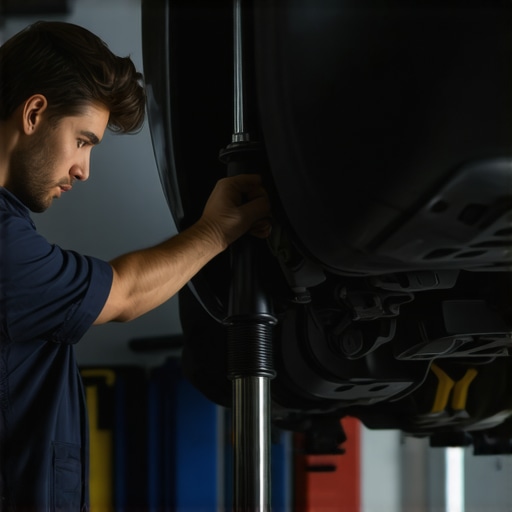
When a vehicle’s ride quality begins to degrade, most drivers point fingers at the tires or blame shifting road conditions. However, seasoned automotive specialists recognize that the hydraulic damper, or shock absorber, is the true unsung hero of kinetic control. Shocks do not merely cushion your drive; they actively manage kinetic energy transfer, ensuring your tires maintain consistent contact with the asphalt. When these critical components fail, safety margins shrink, stopping distances expand, and suspension geometry alters under load. Diagnosing these failures usually occurs on a professional hydraulic lift, but experienced mechanics rely on a series of ground-level, physical telemetry diagnostics to evaluate damper health without advanced shop equipment.
The Real-World Physics of Kinetic Control and Damper Decay
A shock absorber works by converting the kinetic energy of suspension movement into thermal energy, dispersing it through hydraulic fluid. Over millions of cycles, internal piston seals degrade, valve shims fatigue, and the fluid itself shears down, losing its viscosity. This gradual loss of dampening velocity cannot always be seen, but it can be felt and measured through specific vehicle behaviors. For instance, severe front-end dipping during deceleration is a primary indicator of failed front struts, which directly compromises your braking system by prematurely shifting the vehicle’s weight forward. If you suspect your braking efficiency is compromised due to poor weight distribution, it is wise to know if you need brake service immediately before executing deeper suspension diagnostics.
The Classic Bounce Test Re-Engineered for Modern Vehicles
The traditional bumper bounce test is often dismissed as outdated, but when performed with precise mechanical intent, it remains highly effective. Rather than randomly shaking the vehicle, apply your full body weight directly over the wheel arch of a single corner, push down aggressively, and release instantly. A healthy damper will compress, rebound, and settle back to its static ride height immediately. If the chassis oscillates more than one and a half times, the internal valving is blown. This excessive movement mimics the dangerous body roll that causes uneven tire wear and erratic handling. According to suspension dynamics studies by the Society of Automotive Engineers (SAE), uncontrolled wheel hop reduces tire-to-road contact time by up to 30% on rough surfaces, drastically increasing the risk of hydroplaning.
Why Does My Car Dart Left or Right Under Hard Braking?
When shocks are shot, the vehicle’s dynamic alignment changes rapidly under load. If you experience a sudden lateral pulling force when stepping on the pedal, it is frequently due to uneven weight transfer caused by a blown front damper collapsing faster than the opposing side. To understand this phenomenon better and rule out caliper or steering linkage failures, read our diagnostic guide on why your car darts to the left when you hit the brakes. Ground-level diagnostics require looking beyond the components themselves; look closely at your tread blocks. If you spot localized, cup-shaped dips in the rubber, your tires are literally bouncing down the road due to dead dampers. If you want to refine your diagnostic skills further, check out our expert guide on how to tell if your struts are shot without going to a shop to keep your garage diagnostics sharp and accurate.
Detecting the Silent Sign of Hydraulic Fluid Aeration
Experienced mechanics know that a visual inspection for fluid leaks only tells half the story. Inside a decaying shock absorber, hydraulic fluid can mix with pocketed air, a destructive phenomenon known as fluid aeration or cavitation. When this happens, the damper loses its resistive force during rapid transitions, yet it may appear completely dry on the outside. To diagnose this at home without special tools, pay close attention to your steering feedback during quick slalom-like maneuvers. If the steering wheel feels loose and laggy for the first few degrees of input before suddenly tightening up, your struts are likely aerated. This lag represents the piston traveling through compressible foam instead of solid hydraulic fluid.
Aeration does not just ruin your ride comfort; it accelerates wear on your entire steering linkage. The rapid, un-dampened vibrations travel directly through the tie rod ends and steering rack. Drivers often mistake this vibration for a wheel balance issue. If you are trying to isolate the root cause, you can learn how to tell if your tire vibration is a balance issue or a bad belt before replacing perfectly good suspension components.
How Do You Spot Hidden Micro-Friction in the Strut Mount Bearing?
Many DIYers focus solely on the shock cartridge itself, completely overlooking the upper strut mount bearing. This bearing allows the entire strut assembly to rotate smoothly as you turn the steering wheel. When the bearing rusts or loses its grease, it creates micro-friction. This manifests as a subtle, spring-like popping sound or a notched feeling in the steering wheel during low-speed parking lot maneuvers. To test this on the ground, have an assistant turn the steering wheel lock-to-lock while you carefully place your hand on the upper coil spring. If you feel a distinct catching or binding sensation in the spring coils, the upper bearing is seized, even if the shock still has excellent dampening resistance.
Ignoring a seizing strut mount bearing can lead to catastrophic spring failure, where the coil actually snaps under rotational stress. This structural load shift can also mimic a binding steering gear. For more advanced steering diagnostics, consider reading our analysis on why your steering feels notchy while turning to pin down the exact culprit before visiting a shop.
The Thermal Signature Test for Internal Valving Bypass
Because shock absorbers convert kinetic energy into thermal energy, they must get warm during operation. This physical reality offers a highly reliable diagnostic method: the thermal signature test. After driving your vehicle over a moderately bumpy road for ten minutes, safely park and reach behind the tires to feel the metal body of each shock absorber. They should feel warm to the touch. If one shock is stone-cold while the other on the same axle is warm, the cold shock is bypassing fluid internally through worn valving or degraded seals. It is doing zero mechanical work.
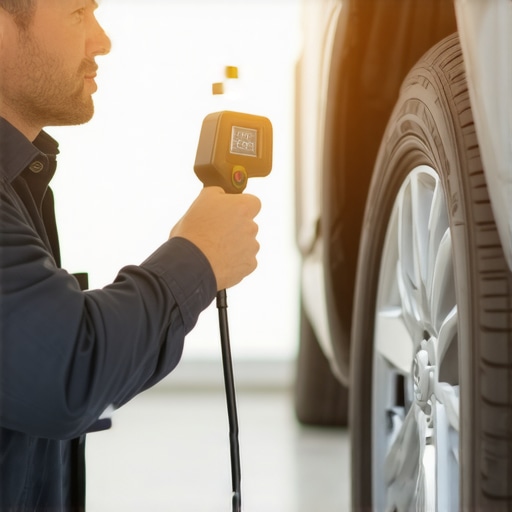
For the most accurate assessment, mechanics use non-contact infrared thermometers to record temperature differentials across the axle. Research published by the American Society of Mechanical Engineers (ASME) highlights that a temperature variance of more than 15 degrees Fahrenheit across a single axle is a definitive indicator of uneven dampening and fluid bypass. If you are finding these diagnostic methods helpful, share your results in the comments below or read our guide on how to find the source of a mystery suspension clunk to solve those elusive underside noises.
Unmasking the Double-Bounce on Independent Suspensions
Modern multi-link and independent rear suspension setups can easily mask a single dead damper by transferring load across the subframe. This mechanical masking means standard bounce tests often fail to reveal a localized failure on the rear axle. To isolate a compromised rear shock without a hoist, you must perform a diagonal load test. By parking the vehicle on a slight incline with the wheels turned fully to one side, you load the suspension unevenly. Pressing down on the unladen corner will isolate the dampening rate of that specific unit. If the rebound feels lazy or finishes with a sharp, metallic snap, the rebound valving is completely spent, leaving your rear tires prone to dangerous toe-in changes during sudden highway lane changes.
Why Do Bad Shocks Cause Accelerated Inner Tire Wear?
When dampening pressure drops below its nominal threshold, the coil spring is left to control the wheel’s vertical travel entirely on its own. This causes the wheel to oscillate rapidly up and down at its natural frequency, a phenomenon known as wheel hop. As the tire repeatedly loses and regains firm contact with the asphalt, it undergoes rapid micro-slippage. This friction scrubs the rubber off the tread blocks, creating a distinct feathering or cupping pattern usually concentrated on the inner shoulder due to the negative camber built into modern performance alignments. If you notice this pattern, it is crucial to address the dampers before performing a wheel alignment, as a fresh alignment cannot compensate for an uncontrolled spring.
The Pressure Differential Test for Gas-Charged Monotube Shocks
High-performance monotube dampers rely on a high-pressure nitrogen gas charge separated from the hydraulic oil by a floating piston. This gas charge, often pressurized to over 250 PSI, keeps the hydraulic fluid under constant tension to completely eliminate cavitation during high-frequency cycles. When the gas charge leaks past the nitrogen chamber seals, the damper experiences a massive drop in static pressure. To diagnose this ground-level condition, measure the vehicle’s static ride height at all four corners from the hub center to the fender arch. A monotube shock that has lost its gas charge will often sit up to a quarter-inch lower than its healthy counterpart on the same axle, as the internal gas pressure actually acts as a helper spring supporting a portion of the vehicle’s corner weight.
For enthusiast drivers, maintaining this precise balance is critical to preserving high-speed stability and preventing mid-corner oversteer. If you want to explore how these subtle geometry changes affect your steering feedback at speed, read our deep dive into the engineering mechanics of steering feedback. Do you have a suspicious vibration or noise during cornering? Leave a comment below explaining your car’s symptoms, and our certified mechanics will help you diagnose the root cause.
Micro-Movement Analysis of High-Frequency Valving Degradation
While macro-level diagnostics like the bounce test reveal catastrophic damper failure, subtle degradation in high-frequency valving requires a more analytical approach. Inside modern multi-velocity dampers, small orifice valves control low-speed body movements like body roll, while spring-loaded shim stacks manage high-speed impacts like potholes. Over time, these delicate shim stacks can suffer from microscopic fatigue or distortion, failing to seal properly. This results in a floating sensation at highway speeds, even though the vehicle passes standard low-speed bounce tests. To detect this specific failure mode on the ground, observe your vehicle’s behavior when crossing small, closely spaced expansion joints. If the suspension feels harsh yet lacks control, the high-speed shim stack has lost its tension, allowing the fluid to bypass too freely before suddenly locking up.
Why Do Some Shocks Feel Stiff When Cold but Loose When Warm?
This temperature-dependent behavior is a classic indicator of advanced hydraulic fluid degradation, specifically a breakdown of the fluid’s viscosity index improvers. As the dampers work, friction heats the internal oil. In high-quality or fresh shock absorbers, the fluid maintains a consistent viscosity across a wide temperature range. However, as the fluid shears down under high shear stress, its viscosity drops drastically as operating temperatures rise. This causes the vehicle to handle sharply for the first five minutes of driving, only to become dangerously floaty and unpredictable once the suspension warms up. If you notice this pattern, it is a sign that the dampers are operating on worn, oxidized fluid that can no longer sustain hydraulic resistance under thermal load.
Ignoring these thermal and high-frequency fluid breakdowns can lead to uneven tire wear and erratic handling. According to suspension engineering standards published by the International Organization for Standardization (ISO), maintaining precise hydraulic damping rates is critical to preventing sudden dynamic load shifts that compromise electronic stability control systems.
Isolating the Sway Bar Linkage from Strut Body Noise
Many mechanics misdiagnose a worn sway bar end link as a blown strut, or vice versa, because both components produce a similar metallic rattling sound over minor road irregularities. To isolate these components without a lift, you must manipulate the vehicle’s stabilizer bar load. Park the vehicle on a level surface, turn the steering wheel to full lock, and have an assistant aggressively rock the vehicle side-to-side from the roof rack or B-pillar. While they shake the car, reach behind the tire and firmly grasp the sway bar end link. If you feel the knocking sensation directly through your hand, the ball joint in the link is worn out. If the noise persists but the link feels solid, the internal piston rod guide in the strut housing has developed excessive lateral play, requiring a complete strut replacement.
Have you encountered a stubborn suspension rattle or unusual handling trait that resists standard garage troubleshooting? Leave a comment below with your vehicle make and specific symptoms, and our expert team will help you decode the physics behind the issue.
Expert Insights & Advanced Considerations
How Dynamic Sag Alters Electronic Braking Systems
When dampers degrade, they do not merely diminish ride quality; they fundamentally disrupt your vehicle’s electronic stability control (ESC) and anti-lock braking systems (ABS). Modern safety modules calculate braking pressure based on expected wheel-load stability. If your dampers allow the tires to bounce—even microscopic amounts—the ABS controller detects a rapid lockup-and-release pattern. The system responds by unnecessarily pulsing the brake pressure, which can lengthen stopping distances by up to 20 percent. Understanding these dynamics is critical, and maintaining your dampers is just as important as knowing why regular brake service is key to car safety and longevity in modern automotive systems.
Why Suspension Preload Masks Faulty Dampers
Performing diagnostic checks on a vehicle with its suspension fully dropped on a standard frame lift can lead to false negatives. When the wheels hang freely, the internal piston travels to an extreme extension zone that is rarely utilized during normal driving. This can temporarily reseal worn piston guides and hide internal bypass issues. To get an accurate diagnostic read, mechanics must evaluate the suspension under its natural preload. If you suspect a deeper issue but cannot locate it on the ground, check out this guide on signs your mechanic found a real suspension problem to ensure you are receiving a precise and honest assessment of your chassis health.
The Hidden Risk of Unbalanced Corner Weights
Replacing only one shock absorber across an axle is a critical mistake that severely compromises handling safety. Even if the companion unit is dry and passes a basic bounce test, its internal fluid has still run through millions of cycles, losing its original viscosity. A mismatched pair of dampers across the front or rear axle creates uneven transient weight transfer during high-speed cornering. This can cause the vehicle to snap-steer unpredictably in one direction while remaining sluggish in the other, a dangerous dynamic that can easily trick you into assuming there is a steering gear failure.
Curated Expert Resources
Society of Automotive Engineers (SAE) Technical Papers
For those who wish to study the exact mathematical models of hydraulic cavitation and vehicle dynamics under load, the SAE database offers peer-reviewed research. These documents detail how micro-oscillations degrade tire traction and alter the lateral slip angle of passenger vehicles during emergency maneuvers.
The International Organization for Standardization (ISO) Friction Standards
ISO publications regarding vehicle ride comfort and mechanical vibration provide the foundational thresholds used by automotive engineers worldwide. These standards define the limits of human-tolerable chassis acceleration, helping you understand how professional test drivers quantify “harshness” and “float” during product development.
AutosCareHub Specialized Troubleshooting Library
To bridge the gap between advanced engineering theory and practical garage solutions, our comprehensive library offers detailed, step-by-step diagnostic workflows. If you need to isolate persistent chassis noises, start by learning how to find the source of a mystery suspension clunk. For those experiencing steering anomalies, our breakdown on why your steering feels notchy while turning offers key insights to pinpoint internal component binding before you begin replacing expensive assemblies.
Final Expert Perspective
Accurate damper diagnostic practices require looking past simple visual cues and embracing the underlying physics of kinetic energy transfer. A failing shock absorber affects tire traction, safety systems, alignment geometry, and braking performance long before it ever begins to leak fluid externally. By mastering advanced diagnostic methods like the thermal signature test, micro-movement analysis, and transient load testing, you can catch subtle performance drops before they compromise safety. Do you have a puzzling ride control issue or an unresolved clunk in your vehicle? Leave a comment below with your symptoms, or reach out to us via our contact page so we can help you decode your suspension dynamics.