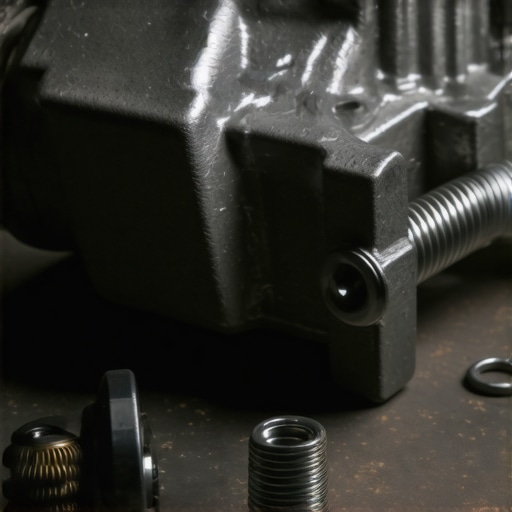
Hydraulic Volatility in the 1-2 Shift Transition
When an automatic transmission begins to hesitate or ‘flare’ during the transition from first to second gear, many vehicle owners immediately fear the worst: a complete gearbox failure. From an engineering standpoint, this specific shift point is one of the most stressful events in a drivetrain’s lifecycle. It requires a precise hand-off between hydraulic circuits and the physical engagement of clutch packs. While a general auto repair shop might recommend a full rebuild, an expert mechanic looks deeper into the hydraulic logic. Often, the culprit isn’t a worn-out gear set but a failure in the pressure regulation system. Maintaining proper fluid viscosity through a thorough tune up checklist is essential, but if the slip persists, the diagnostic focus must shift to the internal components governing the 1-2 accumulator circuit.
The $18 Accumulator Spring Solution for Shifting Woes
In many popular transmission architectures, a small, inexpensive spring is responsible for cushioning the 1-2 shift. Over time, these springs fatigue, crack, or shatter, leading to erratic line pressure and the classic ‘slipping’ sensation. Replacing the 18 dollar accumulator spring is a surgically precise fix that restores factory-spec shifting without the need for a $4,000 transmission replacement. According to technical bulletins from the Automatic Transmission Rebuilders Association (ATRA), these springs are a primary wear item that frequently triggers false diagnostic codes for gear ratio errors. By targeting this specific mechanical failure, you address the root cause of hydraulic bypass that causes the engine to rev between gears. This level of professional diagnostic insight is what separates a parts-changer from a master technician.
Is Your Transmission Actually Dying or Just Starving for Pressure?
One of the most complex inquiries in modern drivetrain diagnostics is whether a slip is mechanical or electrical. A shift solenoid that is failing due to debris or internal heat can mimic the symptoms of a burnt clutch pack. Furthermore, if you notice your transmission fluid is turning black, it suggests the slip has progressed to the point of overheating the friction material. However, before condemning the unit, check the electrical harness. Experts often find that a 15 dollar electrical issue, such as a corroded ground strap or a faulty speed sensor, can disrupt the TCM’s ability to time the shift correctly. Addressing these minor issues during a routine brake service or oil change can prevent the exponential wear that occurs when a transmission ‘hunts’ for the correct gear under load.
Proactive Diagnostics to Avoid a Total Rebuild
Wait times and labor costs at a high-end mechanic shop can be daunting, but ignoring a 1-2 slip is the fastest way to turn a $20 fix into a total loss. When the transmission slips, the internal friction plates generate immense heat, which breaks down the fluid’s protective additives. This creates a feedback loop where poor lubrication leads to more slipping. If you suspect your shifting issues are becoming a safety hazard, learn how a top-rated mechanic ensures safe auto repairs before committing to a major overhaul. Identifying the difference between a broken spring and a compromised valve body requires specific pressure testing tools that go beyond basic OBD-II scanners. Professional-grade auto repair demands this layered approach to ensure the vehicle remains reliable for another 100,000 miles.
Why Your Engine Controls Hold the Key to Smooth Shifting
The Transmission Control Module (TCM) does not operate in a vacuum; it is constantly fed a stream of data from the engine’s sensor network to determine the ideal shift pressure and timing. If the Mass Air Flow (MAF) sensor is contaminated, the TCM miscalculates the engine load, often resulting in shift points that feel ‘late’ or excessively harsh. Many drivers waste thousands on internal auto repair when they could have addressed the issue by learning how to clean your own MAF sensor in under fifteen minutes. This lack of data integrity causes the hydraulic system to spike pressure, which accelerates wear on the friction plates and seals. When the computer cannot accurately gauge how much torque the engine is producing, it defaults to a ‘limp mode’ or high-pressure logic that saves the clutches but ruins the driving experience.
Could a Dirty Air Intake Be the Real Reason Your Car Won’t Shift?
It sounds counterintuitive to the average car owner, but an intake leak or a failing throttle position sensor can completely destabilize the shift schedule. A small air bypass after the sensor causes the engine to lean out, which the TCM interprets as a low-load condition even when you are accelerating hard. Before you assume the internal clutches are burnt, investigate the peripheral components. For instance, the 15 dollar sensor that stops your transmission from hunting for gears is often a simple input speed sensor or a MAP sensor that has drifted out of calibration. According to Transmission Digest, a leading publication for drivetrain specialists, up to 30% of diagnostic ‘ghosts’ in late-model vehicles are resolved by fixing engine-side data errors rather than opening the transmission case.
Don’t Let a $9 Vacuum Hose Cost You a Gearbox
In older hydraulically controlled or vacuum-modulated systems, the connection between the engine and the gearbox is physical. A cracked or dry-rotted line can trick a mechanic into thinking the entire unit needs an overhaul. In reality, the 9 dollar vacuum hose that manages the modulator might be the only thing standing between you and a smooth commute. This is why a meticulous tune up is so vital; it’s not just about spark plugs, but about the integrity of the hoses and wires that allow the drivetrain components to communicate. If you’ve encountered a strange shift lately, share your experience in the comments below—identifying these patterns helps the entire community avoid unnecessary repair costs.
Master the Art of Electrical Grounding to Save Your Drivetrain
Modern vehicles are essentially rolling computers, and computers require stable voltage to function. A weak battery or a corroded ground strap can cause ‘noise’ in the electrical circuit, leading to erratic solenoid behavior. You can use the 10 dollar multimeter trick to verify that your charging system isn’t starving the TCM of the current it needs to actuate the shift valves. Furthermore, the quality of your maintenance items matters more than you think. While it may seem unrelated, why cheap oil filters are costing you horsepower often ties back into the overall efficiency and heat management of the engine bay. Similarly, the debate over the truth about high mileage oil is worth considering if you want to protect the seals that also exist within the transmission cooling circuit. High-level auto repair is about seeing the vehicle as a unified system where a failure in one area inevitably migrates to another.
How Pulse Width Modulation Dictates Every Gear Change
The evolution of the automatic transmission has transitioned from purely hydraulic ‘brains’ to sophisticated electronic actuators. In modern systems, the shift quality is determined by Pulse Width Modulation (PWM), where the TCM rapidly cycles solenoids to feather pressure. When a mechanic hooks up a high-end oscilloscope, they aren’t just looking for a signal; they are looking for the ‘square wave’ that proves the solenoid is responding fast enough. If the duty cycle is compromised by internal resistance, the shift will feel ‘clunky’ even if the fluid is clean. This is where high-level auto repair diagnostics become vital, as a simple resistance test with a multimeter often fails to catch a solenoid that is mechanically slow but electrically within spec.
Can a Failing Alternator Directly Cause Harsh Transmission Engagement?
Absolutely. A ripple in the DC voltage caused by a failing diode in the alternator can introduce ‘noise’ into the electrical system that confuses the TCM. Because solenoids are electromagnetic, any fluctuation in power affects the magnetic field strength required to move the internal pintle. A car that requires a tune up might actually be suffering from an aging battery that drops to 11 volts during a shift event, causing the solenoid to lag. This lag creates a timing mismatch between the off-coming and on-going clutch packs, resulting in that dreaded ‘bang’ into gear. According to technical documentation from the Society of Automotive Engineers (SAE), electrical transients are a leading cause of intermittent shift logic errors in ZF and Aisin-Warner platforms, often misdiagnosed as mechanical failure.
Internal Cross-Leaks That Steal Your Shift Pressure
Even with perfect electronics, the physical casting of the valve body can become a liability over time. Over millions of cycles, the steel valves wear away at the softer aluminum bores in a process known as ‘bore wear.’ This creates ‘cross-leaks’ where hydraulic pressure intended for the forward clutch bleeds into the reverse circuit or back to the sump. This is why a simple brake service or oil change often turns into a diagnostic session when the driver mentions a slight delay when shifting from Park to Drive. If you are experiencing these symptoms, don’t wait for a total breakdown; investigate the vacuum test results of your valve body bores to see if a specialized sleeve kit can save the unit before the clutch material is completely incinerated. Identifying these early-stage leaks requires a specialized mechanic who understands the subtle drop in line pressure that occurs during ‘hot’ operation.
Why Heat is the Silent Killer of Every Automatic Gearbox
Transmission fluid serves as both a hydraulic medium and a vital coolant for the internal friction components. When the internal bypass valve in the radiator fails, or the auxiliary cooler becomes clogged with metallic debris, the fluid temperature can spike to over 240 degrees Fahrenheit. At these temperatures, the long-chain polymers in synthetic fluid begin to shear, losing their ability to maintain a consistent ‘film’ between the friction plates. This thermal runaway is often the final stage before a complete auto repair rebuild is required. Ensuring your cooling system is part of every seasonal tune up prevents the fluid from oxidizing prematurely and turning into the dark, burnt liquid that signals the end of a transmission’s life. If you have noticed your car shifts perfectly when cold but ‘flares’ once it reaches operating temperature, the cooling circuit and fluid viscosity are the first places to look. Feel free to reach out if you need advice on measuring your transmission’s peak operating temperature during heavy towing.
Surface Tension and the Mystery of Aerated Fluid
One often overlooked aspect of hydraulic stability is the introduction of air into the system, known as aeration. When a transmission is overfilled or if a filter seal is cracked, the rotating assembly can whip the fluid into a foam. Air is compressible, whereas hydraulic fluid is not; when foamy fluid enters a solenoid, the resulting pressure is inconsistent and ‘spongy.’ This leads to a slow engagement that feels like a slip but is actually a lack of hydraulic density. A professional mechanic will check for bubbles on the dipstick as a primary diagnostic step before suspecting a hard-part failure.
Wipe the Slate Clean with Adaptive Reset Rituals
Modern Transmission Control Modules (TCMs) are designed with ‘adaptive learning’ algorithms that compensate for internal wear by gradually increasing line pressure or adjusting shift timing. While this engineering marvel extends the life of a gearbox, it can also mask the early warning signs of a 1-2 shift slip. When a mechanic replaces a component like the accumulator spring, the TCM may still be applying the high-pressure logic it learned to overcome the previous failure. This results in a ‘harsh shift’ that feels like a new problem. Performing a proper adaptive reset—often requiring a high-level bidirectional scan tool—is a mandatory step in any auto repair involving the drivetrain. Without this software-level calibration, the mechanical fix remains incomplete, as the computer continues to fight a ghost that no longer exists.
Is Your Torque Converter Shuddering at the Finish Line?
Distinguishing between a gear-to-gear slip and a Torque Converter Clutch (TCC) shudder requires a seasoned ear and precise data logging. A TCC shudder typically occurs in higher gears at lower RPMs, feeling much like driving over rumble strips, but it can occasionally interfere with the 1-2 transition in high-torque applications. If a tune up and fluid change don’t resolve the vibration, the issue might lie in the TCC apply valve within the valve body. According to the fluid dynamics experts at Sonnax Industries, the wear in the TCC regulator sleeve is a notorious point of failure that causes hydraulic oscillation. Addressing this specifically often prevents the need for a total torque converter replacement, saving thousands in labor and parts.
When Case Porosity Sabotages Your Best Pressure Tests
In rare but baffling scenarios, a mechanic might find that every solenoid, spring, and seal tests perfectly, yet the 1-2 flare persists. This is often where the ‘pro’ level of auto repair enters the realm of metallurgy. Case porosity—microscopic voids in the aluminum casting of the transmission case—can allow high-pressure fluid to seep through the metal walls into adjacent low-pressure channels. This internal ‘bleeding’ is nearly impossible to see with the naked eye but becomes apparent under a vacuum test of the case itself. While this sounds catastrophic, specialized epoxy sealants or sleeve kits can sometimes reclaim the case without requiring a core swap. It is the kind of specialized knowledge that transforms a frustrating diagnostic ‘dead end’ into a successful, long-term recovery.
The Subtle Art of Analyzing Clutch Volume Indices
To truly understand the health of your 1-2 shift, you must look at the Clutch Volume Indices (CVI). This data point, accessible through the TCM, represents the volume of fluid required to apply a specific clutch pack. As the friction material wears down, the piston must travel further, and the CVI value rises. Monitoring these numbers during a routine brake service or inspection allows a technician to predict a failure before it leaves you stranded. If your CVI for the underdrive or 2nd-gear clutch is significantly higher than factory spec, the mechanical ‘slip’ is already occurring at a microscopic level. Have you ever checked your vehicle’s CVI values during a diagnostic session? Let us know in the comments if your scan tool reveals a looming hardware failure so we can help you strategize the most cost-effective fix.
Don’t Ignore the Harmonic Balancer in Your Shift Equation
It may seem unrelated to the gearbox, but the harmonic balancer on your engine’s crankshaft plays a role in shift quality. Excessive engine vibration caused by a degraded balancer can send ‘dirty’ rotational data to the input speed sensor. The TCM interprets these erratic pulses as a slip, causing it to spike line pressure as a fail-safe. Incorporating a visual check of the balancer into your regular tune up ensures that the data being fed to the transmission is clean and stable. Professional auto repair is rarely about a single isolated part; it is about the synergy between every rotating component from the front pulley to the rear differential.
Expert Insights & Advanced Considerations
Ditch the Standard Multimeter for an Oscilloscope
While the 10 dollar multimeter trick is perfect for checking static voltage, it often fails to capture the high-speed glitches of a Pulse Width Modulated (PWM) solenoid. To truly see why a shift is flaring, an expert mechanic uses a scope to visualize the waveform. This allows you to spot a ‘lazy’ solenoid pintle that is electronically active but mechanically slow due to debris or varnish. Integrating this level of data into your thorough tune up checklist transforms your diagnostic capability from guesswork to precision engineering.
Fluid Shear and the Molecular Breakdown of Friction
Many drivers ignore the early signs of gear slippage until they notice their transmission fluid is turning black. By this stage, the fluid has suffered from molecular shear, meaning the viscosity index improvers have literally been torn apart by heat and pressure. An advanced auto repair strategy involves checking the fluid’s clarity under a microscope or with a blotter test early on. If the fluid loses its ability to maintain surface tension, the 1-2 shift transition becomes physically impossible to cushion, regardless of how new the mechanical parts are.
Trust the Adaptive Learning Reset After Every Repair
One of the most common mistakes after installing the 18 dollar accumulator spring is failing to reset the Transmission Control Module’s (TCM) adaptive memory. The computer has likely spent months ‘learning’ to compensate for a weak spring by ramping up line pressure. Without a software-level reset, the car will continue to shift with excessive force, potentially damaging new components. Understanding these software nuances is how a top-rated mechanic ensures safe auto repairs and prevents ‘ghost’ symptoms from haunting a fresh rebuild.
Curated Expert Resources
ATSG Technical Manuals
These manuals are the gold standard for anyone looking to go beyond basic auto repair. They provide specific hydraulic flow charts and ‘check-ball’ locations that are essential for diagnosing internal leaks in the 1-2 circuit.
Sonnax Valve Body Mapping
For those diving into high-level diagnostics, Sonnax offers the best documentation on vacuum testing valve bodies. Their research into ‘bore wear’ explains why a transmission might slip only when hot, a nuance often missed during a standard tune up.
Transmission Digest Technical Archive
This industry publication offers deep dives into real-world case studies. It is an invaluable resource for finding professional diagnostic insight on rare ‘pattern failures’ that generic scanners can’t detect.
Final Expert Perspective
Solving a 1-2 shift flare requires a shift in perspective; you must stop viewing the transmission as an isolated box and start seeing it as the heart of a complex, networked system. Whether the fix is an electrical ground or a mechanical spring, the key to longevity lies in proactive maintenance and sophisticated data analysis. By following auto repair cost saving tips from industry experts, you can avoid the financial burden of a complete gearbox replacement. If you have encountered a persistent shift issue, we invite you to share your diagnostic findings or reach out for more advanced technical guidance. Your auto repair journey doesn’t have to be a gamble when you have the right data in hand.