
The Gatekeeper of Stoichiometry and Why It Matters
The efficiency of a modern internal combustion engine rests upon the precision of its stoichiometric ratio, specifically the 14.7:1 air-to-fuel balance required for peak thermal performance. Central to this equilibrium is the Mass Air Flow (MAF) sensor. Over time, even the most meticulous auto repair schedule can overlook the gradual accumulation of microscopic debris on the sensor’s delicate sensing element. This build-up forces the Engine Control Unit (ECU) to rely on inaccurate data, leading to sluggish acceleration and increased fuel consumption. To truly tune up your car like a pro, one must understand that restoration starts with data accuracy.
Your ECU is Blinded by Micro-Contaminants
A fouled sensor doesn’t always trigger a check engine light immediately. Instead, it causes a slow degradation of performance as the platinum hot-wire becomes insulated by dust and oil vapor. This insulation inhibits the wire’s ability to cool down as air passes over it, causing the ECU to under-calculate the actual air mass entering the cylinders. According to research published by SAE International, sensor fouling is a leading cause of long-term fuel trim drift in high-mileage vehicles. While a professional mechanic might charge a premium for diagnosis, identifying these subtle shifts in performance is the first step in advanced auto repair.
Does a Dirty Sensor Trick Your Car into Thinking It is Out of Breath?
Yes, and the symptoms are often confused with more expensive mechanical failures. When the sensor sends a low-voltage signal due to contamination, the ECU leans out the fuel mixture. This can result in a hesitation during acceleration that many drivers mistake for a transmission slip. In reality, it may just be the 10 cleaning move that saves your MAF sensor from total replacement. By carefully applying a specialized solvent, you can strip away the carbon film without damaging the fragile circuitry within. [IMAGE_PLACEHOLDER]
Stop Losing Power to the Invisible Dust Film
Restoring lost horsepower is not always about adding new parts; often, it is about reclaiming the efficiency the manufacturer originally engineered. Just as a routine brake service is vital for safety, cleaning the intake path is vital for longevity. If you notice your engine stumbling at red lights or surging under load, it is time to look beyond basic maintenance. For those diving deeper into diagnostic work, using mechanic tips for diagnosing common auto problems can help you distinguish between a simple intake leak and a sensor failure. If you have noticed a significant drop in your miles per gallon, we encourage you to share your findings or ask questions in our community forum to help others refine their tune up strategies.
Mastering the Precision of Intake Maintenance
Precision is the hallmark of the expert. When cleaning the MAF, never use brake cleaner or carb cleaner, as the harsh chemicals can dissolve the protective coatings on the sensor. Instead, use a dedicated MAF sensor cleaner that evaporates quickly without leaving a residue. This simple task is a cornerstone of the essential guide to auto repair that every performance-minded owner should master. By ensuring the ECU receives a high-fidelity signal, you allow the engine to operate at its full potential, effectively reclaiming the power lost to years of neglect.
Ignition Precision Beyond the Standard Spark Plug Swap
While cleaning the MAF sensor addresses the ‘air’ side of the equation, the ‘fire’ side—your ignition system—requires equal scrutiny. Most DIYers stop at replacing plugs based on a mileage interval, but true experts look at the flame kernel’s position. This is where you can index your spark plugs for better efficiency, ensuring the open side of the gap faces the intake valves to promote a more complete combustion cycle.
Could the Way You Screw in a Plug Change Your Gas Mileage?
Indeed, even a few degrees of orientation can influence how rapidly the flame front spreads. A poorly oriented plug can lead to incomplete burns, resulting in the carbon buildup that eventually leads to ‘sticking valves.’ If you suspect your engine is already suffering from these deposits, consider the $15 additive that actually helps sticking valves before committing to a costly teardown in the auto repair shop. Beyond simple part swapping, ensuring the correct gap and orientation is what separates a basic service from a high-performance tune up.
Hunt Down the Air That Your Sensor Never Saw
A common frustration in auto repair is chasing a rough idle when the MAF sensor is perfectly clean. This often indicates ‘unmetered’ air entering the system through a cracked vacuum hose or a degraded gasket. Because this air enters after the sensor, the ECU doesn’t account for it, causing a lean condition. You can easily find an intake leak using only a $5 bottle of soapy water, which is a far more cost-effective approach than blindly replacing components. This is often the primary reason why your car stumbles at red lights but runs fine on the highway, where the higher volume of air masks the small leak. When inspecting the intake manifold, do not forget the throttle body’s butterfly valve; carbon buildup here can restrict airflow at idle, mimicking a failing fuel pump. 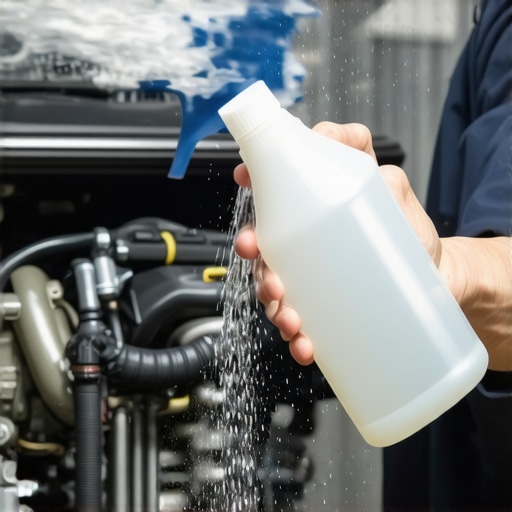
The Electrical Foundation of the Combustion Cycle
A high-performance tune up is incomplete without verifying the health of your charging system. If your alternator is struggling to maintain a consistent voltage, the ignition coils cannot produce a strong enough spark to bridge the gap under high cylinder pressure. Professional technicians often use the $10 multimeter trick for spotting a dying alternator before it strands you. This simple electrical check ensures that every other component you have serviced has the power it needs to function. Furthermore, verifying engine grounds is a neglected art. High resistance in a ground wire can introduce electrical noise into the ECU’s sensor signals, leading to phantom codes and intermittent performance glitches. Often overlooked, the Positive Crankcase Ventilation (PCV) valve is also essential for maintaining crankcase pressure. A stuck valve can cause the engine to pull in too much oil vapor, fouling your new spark plugs. In many cases, the $9 PCV valve that stops your engine from consuming oil is the missing link in a comprehensive maintenance plan.
Why Preventative Maintenance is Your Best Financial Hedge
According to data from the Car Care Council, over 80% of vehicles on the road fail at least one component of a basic inspection, with vacuum and emission-related parts being frequent offenders. Proactive maintenance is not merely about avoiding breakdowns; it is about maximizing the investment you have made in your vehicle. To ensure your vehicle remains at peak performance and retains its value, refer to the ultimate tune-up checklist for every car owner. If you have ever struggled with a mystery hesitation or a sudden drop in power, join our community discussion below and share which diagnostic step finally solved the issue for you.
Look Past the Dashboard for Real-Time Fuel Trim Secrets
Analyzing fuel trim data is the equivalent of a comprehensive blood test for your engine. While a basic tune up involves the physical replacement of worn parts, an advanced diagnostic approach prioritizes the interpretation of numerical data streams. Long Term Fuel Trim (LTFT) provides a historical perspective of the ECU’s struggle to maintain stoichiometry. If your LTFT is consistently pushing above positive 10%, your engine is actively compensating for a lean condition, perhaps signaling a fuel pump losing its flow rate or a micro-leak in the intake manifold. Conversely, negative trims suggest the engine is ‘choking’ on too much fuel, often due to high fuel pressure or a leaking injector. If you are unsure how to interpret these percentages, check out our guide on interpreting OBDII data like a master tech to begin seeing what your vehicle’s brain sees.
Can a Failing Coolant Sensor Trap Your Car in a High-Fuel Loop?
Surprisingly, yes. The Engine Coolant Temperature (ECT) sensor is the primary conductor of the fuel-mapping orchestra. During a cold start, the ECU operates in ‘open loop,’ delivering a rich mixture to stabilize the combustion process. Once the engine reaches a specific thermal threshold, it switches to ‘closed loop’ to maximize efficiency. However, a ‘lazy’ sensor that fails to report the correct operating temperature—even by just twenty degrees—can prevent this transition. This keeps your vehicle in a permanent state of over-fueling, which washes the cylinder walls with unburnt gasoline, dilutes your motor oil, and causes carbon to bake onto the valves. This thermal mismanagement is why even a routine brake service or oil change can’t save an engine that is being slowly corroded from the inside by its own fuel strategy.
Stop the Silent Killers with Better Injector Latency and Atomization
Fuel injectors do not simply ‘work’ or ‘fail’; they exist on a spectrum of efficiency that degrades over hundreds of millions of cycles. When an injector develops internal friction, its ‘latency’—the time it takes for the pintle to physically open after receiving an electrical pulse—increases. This delay, measured in microseconds, creates a lean spike that the ECU cannot always anticipate. Furthermore, carbon buildup on the nozzle disrupts the spray pattern, turning a fine mist into heavy droplets that do not burn completely. According to technical documentation from Bosch Mobility, even a 5% deviation in injector flow can create enough cylinder-to-cylinder variance to cause a rough idle that standard diagnostic tools might miss.  To restore that ‘factory-fresh’ throttle response, focusing on the quality of fuel delivery is a non-negotiable step in high-level auto repair.
Thermal Strategy and the Hidden Cost of a Lazy Thermostat
Efficiency isn’t just about the fuel you put in; it’s about the heat you keep. A thermostat that hangs slightly open is a frequent culprit behind poor gas mileage and lackluster cabin heat. If your engine takes more than five minutes of driving to reach its median operating temperature, your tune up should include a cooling system overhaul. A cooling system that operates too cold prevents the engine oil from reaching the temperature required to evaporate moisture and acids, leading to sludge formation. This hidden parasitic loss forces the mechanic to look beyond the obvious. When you address the thermostat and the ECT sensor together, you are essentially recalibrating the engine’s thermodynamic baseline. Mastering these variables is what turns a standard garage session into a professional-grade restoration of performance. If you are ready to dive deeper into the hardware, take a look at our breakdown of the best OBD2 scanners for advanced home mechanics to start monitoring your thermal cycles in real time.
VVT Solenoids Require Surgical Cleanliness to Function
As you refine your tune up, you must look toward the hydraulic intricacies of Variable Valve Timing (VVT). Modern engines use oil pressure to phase the camshafts, allowing for a broader torque curve and reduced emissions. However, these systems are notoriously sensitive to oil quality. If microscopic sludge deposits build up within the VVT solenoid, the oil flow becomes restricted, leading to ‘hydraulic hysteresis’ where the cam timing lags behind the ECU’s commands. This slight delay causes a mismatch between the piston position and valve opening, effectively killing your volumetric efficiency. To maintain peak performance, advanced auto repair necessitates not just changing the oil, but ensuring the use of high-detergency synthetics that keep these delicate passages clear. 
Does Your Exhaust Backpressure Steal Your High-End Torque?
A frequently overlooked aspect of engine health is the ability of the cylinders to exhale. Even a perfectly metered air-fuel charge cannot combust efficiently if the previous cycle’s spent gases are still lingering in the chamber. This happens when a catalytic converter becomes partially restricted or a muffler baffle collapses internally. High backpressure creates a ‘choking’ effect that forces the engine to work harder just to pump air out, which shows up in your diagnostic data as an artificially high engine load at idle. According to technical bulletins from the National Institute for Automotive Service Excellence (ASE), verifying exhaust integrity with a vacuum gauge or backpressure tester is a critical step for a professional mechanic when traditional ignition or fuel checks come up empty. When the exhaust path is clear, scavenging—the process where the exit velocity of exhaust gases helps pull in the next intake charge—can function as intended, significantly boosting power.
Can a Clogged Catalytic Converter Mimic a Failing Fuel Pump?
Yes, and the diagnostic overlap is frustratingly common. Both issues lead to a severe loss of power under high-load conditions, such as climbing a hill or merging onto a highway. However, while a failing fuel pump causes a lean condition (high positive fuel trims), a restricted exhaust often shows normal fuel trims but a significant drop in manifold vacuum as RPMs rise. Distinguishing between these two requires a methodical approach to auto repair, starting with a simple vacuum test. If your vacuum drops steadily while holding a steady 2,500 RPM, the engine is likely ‘constipated’ by its own exhaust. This is why a comprehensive essential guide to auto repair must include a deep dive into the mechanical breathing of the engine, not just its electronics.
Stop Fighting Your Own Drivetrain for Horsepower
True efficiency extends beyond the combustion chamber and into the wheels. You might have the most finely tuned engine in the city, but it will feel sluggish if it is fighting parasitic drag in the chassis. A sticking brake caliper is a silent power thief that many drivers ignore until they smell burning friction material. This is why a thorough brake service is a performance upgrade; by ensuring the pads retract fully from the rotor, you eliminate the constant resistance that forces the engine to burn more fuel just to maintain speed. Similarly, poor wheel alignment can increase rolling resistance, effectively acting like a permanent anchor. If you want to see the true results of your tune up, you must ensure the path from the crankshaft to the asphalt is as frictionless as possible. We recommend logging your ‘Engine Load’ PID during a steady-state cruise on a flat road; if the load is higher than 20%, it is time to check for dragging brakes or failing wheel bearings. Join our forum to share your data logs and see how your vehicle compares to others in its class!
Expert Insights & Advanced Considerations
Stop Treating Fuel Trim Like a Simple Number
When you look at Short Term Fuel Trim (STFT), you are seeing the ECU’s immediate reaction to a localized event. However, the real master of auto repair focuses on the Long Term Fuel Trim (LTFT) trend lines. A consistent positive shift often points to aging injectors or a micro-leak in the intake manifold that only manifests under specific thermal loads. To truly enhance car longevity, you must learn to read these digital fingerprints before they manifest as mechanical failure.
Thermal Drift Quietly Destroys Engine Efficiency
A “lazy” thermostat that stays open just a fraction of a millimeter can keep your engine in a permanent state of rich-running sub-efficiency. This isn’t just about fuel economy; it’s about oil chemistry. When the engine fails to reach its design temperature, moisture and fuel blow-by never evaporate, leading to the sludge that eventually clogs VVT solenoids. This is why saving money on auto repairs starts with verifying your operating temperature with a scan tool rather than just relying on the dashboard needle.
Hidden Parasitic Drag is the Ultimate Power Thief
You can perform the most meticulous tune up in the world, but it won’t matter if your drivetrain is fighting itself. A slightly dragging caliper—often caused by collapsed internal brake hoses—can mimic the symptoms of a failing transmission or a loss of low-end torque. This makes a professional brake service more than just a safety measure; it is a critical performance verification step. Check your rolling resistance by monitoring engine load percentages during a flat-road cruise to ensure every bit of horsepower reaches the pavement.
Curated Expert Resources
SAE International: The primary source for technical standards defining modern stoichiometry and sensor communication protocols. Essential for anyone wanting to understand the engineering logic behind your vehicle’s computer.
Bosch Mobility: As the original equipment manufacturer for many fuel and ignition systems, their technical documentation provides the deepest look into injector latency and spray pattern optimization.
ASE (National Institute for Automotive Service Excellence): Their study guides and technical bulletins offer the most reliable data for distinguishing between electrical phantom codes and genuine mechanical failures.
The Car Care Council: A vital resource for statistical data on vehicle neglect and the long-term financial impact of deferred maintenance strategies.
Final Expert Perspective
Restoring a vehicle to its peak performance requires moving beyond the basic tune up mindset of simply swapping parts based on a calendar. True expertise in auto repair is found in the synthesis of data—interpreting fuel trims, verifying thermal baselines, and eliminating parasitic drag through a comprehensive brake service. By working with the precision of a seasoned mechanic and mastering the invisible variables of airflow and electrical fidelity, you allow the engine to function as the high-performance machine it was intended to be. We invite you to join our professional community below to share your diagnostic logs and discuss the advanced strategies that have solved your most persistent performance puzzles.