Precision Diagnostics Overcome the Expensive Parts-Cannon Mentality
The modern automotive repair landscape is often dominated by a ‘replace rather than repair’ philosophy, frequently leading to unnecessary expenditures for the average vehicle owner. When a driver experiences a distinct clunking or clicking sensation through the steering wheel, particularly during low-speed maneuvers or when traversing uneven pavement, many shops reflexively recommend a full steering rack replacement. However, seasoned mechanics specialized in diagnosing common auto problems know that the culprit is frequently a tiny, star-shaped rubber damper located within the electric power steering (EPS) motor assembly. This component, often costing less than ten dollars, serves as a crucial buffer between the motor and the steering column shaft. When it disintegrates, the metal-on-metal contact creates the unsettling noise that many mistake for a catastrophic failure of the entire gear assembly. Mastering this specific diagnostic nuance is what separates a world-class skilled mechanic you can trust from a simple technician.
The $8 Flexible Coupler That Silences Steering Column Vibrations
Technically referred to as a flexible steering coupler, this small elastomer piece is engineered to absorb torsional vibrations and dampen the feedback from the road before it reaches the driver’s hands. Over time, heat cycles and constant torque application cause the rubber to become brittle and eventually shred. This is a common issue in various vehicles from the late 2000s and early 2010s, where the transition to electric power steering introduced new NVH (Noise, Vibration, and Harshness) challenges. To diagnose a mystery clunk in your front end, one must look beyond the struts and ball joints. By removing the lower dashboard panels and accessing the EPS motor housing, a professional can swap the failed bushing in under two hours. This surgical approach to auto repair maintains the integrity of the original steering rack while saving the consumer thousands in parts and labor. Following industry standards from organizations like the National Institute for Automotive Service Excellence (ASE) ensures that these minor fixes meet the rigorous safety requirements of the modern highway.
How do you distinguish between a failed intermediate shaft and a worn bushing?
Differentiating between these two common steering issues requires a systematic analytical approach. An intermediate shaft failure usually presents as a ‘binding’ or ‘notchy’ feel that occurs at specific points in the steering wheel’s rotation, often accompanied by a heavy sensation. In contrast, a worn EPS coupler produces a sharp, tactile click even with small, rapid movements of the steering wheel while the vehicle is stationary. While you are addressing these steering components, it is an excellent opportunity to maximize your brake service efficiency by inspecting the front-end suspension and rotors while the vehicle is in the service bay. Integrating a comprehensive tune up checklist during this process ensures that every related system, from steering feedback to ignition timing, is optimized for the long road ahead. If your steering feels loose or noisy, don’t wait for a total failure—investigate the simple solutions that provide professional-grade results.
Don’t Let Old Fluid Compromise Your Stopping Power
The intricate dance of hydraulic pressure in your braking system relies on one critical, often overlooked factor: the boiling point of your fluid. Brake fluid is naturally hygroscopic, meaning it acts like a sponge for atmospheric moisture. Over time, this water contamination significantly lowers the temperature at which the fluid vaporizes. Under heavy braking or during long descents, this trapped moisture can boil, turning into gas. Unlike liquid fluid, gas is compressible, leading to that terrifying ‘spongy’ pedal feel that reduces stopping distance exactly when you need it most. To maintain peak safety, you must move beyond basic pad replacement and master brake service secrets that boost longevity. Regularly using a refractometer or electronic tester is the only way to accurately test your brake fluid for water content at home. The National Highway Traffic Safety Administration (NHTSA) emphasizes that degraded brake fluid is a leading cause of hydraulic component corrosion, which can eventually lead to internal seal failure in the master cylinder. 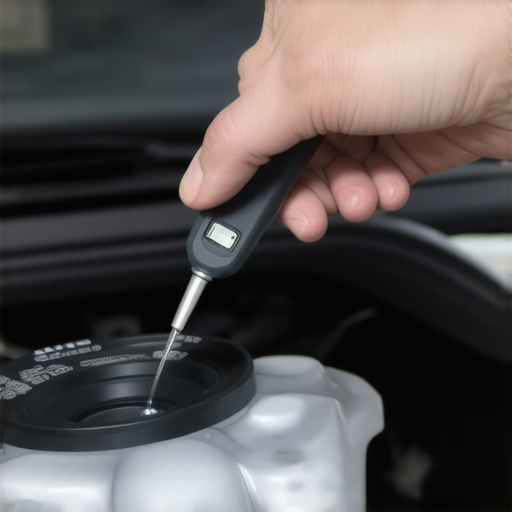
Why does your brake pedal sink only when it’s raining?
This specific phenomenon often points to a combination of worn external seals and the cooling effect of road spray on the brake lines. When rain hits hot brake components, it can cause rapid temperature fluctuations that expose microscopic leaks in the vacuum booster or the master cylinder’s secondary seals. If you notice this pattern, it is vital to understand why your brake pedal sinks to the floor only when it is raining to prevent a total loss of pressure during an emergency stop. Addressing these environmental triggers early is a hallmark of proactive maintenance.
Solve Transmission Shifting Woes Without a Rebuild
Many drivers panic when they experience a jarring thud during the first few miles of their morning commute. However, why your transmission shifts hard only when the engine is cold is usually a matter of fluid viscosity and sensor calibration rather than internal gear damage. Modern transmissions use complex solenoids that require specific fluid pressures to operate smoothly; when the fluid is thick and cold, old or contaminated oil cannot flow through the narrow passages quickly enough. Before committing to a four-figure overhaul, consider that the $20 fluid swap can often save a slipping transmission by restoring the proper friction modifiers required for smooth clutch engagement. This approach aligns with broader tune up strategies to save money on auto repairs, focusing on fluid integrity rather than mechanical replacement. Even a simple 12-dollar spark plug boot error can cause engine hesitations that mimic transmission shudder, further proving that a holistic diagnostic view is essential. Have you ever saved a ‘dying’ car with a simple fluid change? Share your success story in the comments below or let us know which mystery sound is currently driving you crazy.
Stop Chasing Codes and Start Testing Circuits
In the era of rolling supercomputers, the most misunderstood system is the Controller Area Network, or CAN bus. While a generic scan tool might point to a failed oxygen sensor or a throttle body malfunction, a seasoned diagnostic expert looks for the ‘silence’ between the modules. High-resistance connections or a frayed wire can introduce noise into the data stream, causing multiple control units to report ‘lost communication’ errors. Instead of throwing parts at every trouble code, use an oscilloscope to visualize the square waves of the data signals. This level of advanced electrical diagnostics allows you to pinpoint a single pin-fitment issue that could otherwise lead to weeks of frustration. When the network is healthy, the car functions as a singular, harmonious unit; when it is compromised, it behaves like a collection of broken appliances, throwing disparate codes for the ABS, transmission, and engine all at once. This ‘ghost’ is often just a loose ground strap or a corroded connector hidden behind a wheel well liner. 
Why do modern cars throw transmission codes when the battery is weak?
This nuance often catches even experienced DIYers off guard. Modern electronic control modules (ECMs) are incredibly sensitive to voltage fluctuations. During a cold start, a battery that is internally failing might drop below 10 volts momentarily. While the engine might still crank and fire, the transmission control module (TCM) may fail to initialize properly, triggering a ‘limp mode’ or a hard shift code that has nothing to do with the mechanical health of the gears. This is where verifying battery health beyond a simple voltage test becomes the first step in any transmission diagnosis. According to research published by SAE International, signal integrity in automotive networks is directly correlated to stable power supply rails, meaning a clean 12.6V base is non-negotiable for accurate data processing. Neglecting the health of the chemical cells in your battery can lead to thousands of dollars in misdiagnosed electrical components.
Silence the Ticking with a VVT Solenoid Deep-Clean
Another common misdiagnosis involves the rhythmic ‘ticking’ or ‘clattering’ often heard in modern Variable Valve Timing (VVT) systems. Many owners fear a failing timing chain, yet the issue frequently stems from a clogged oil control valve (OCV) or solenoid. These components rely on microscopic screens to filter the oil that hydraulically adjusts the camshaft position. If your oil change intervals have been inconsistent, sludge can restrict these ports, causing timing lag and rough idling. Before you authorize a $2,000 timing job, try a specialized VVT solenoid cleaning procedure to restore oil flow. This simple maintenance step can often eliminate ‘retarded timing’ codes and restore lost fuel economy in a single afternoon. If you’ve ever been quoted for a major engine rebuild only to find a $50 sensor or a dirty valve was the culprit, your experience is invaluable to other drivers—tell us about your most surprising ‘cheap fix’ below. Mastering the relationship between lubricant quality and mechanical timing is the bridge between basic ownership and true automotive stewardship. Even the highest-quality synthetic oil cannot overcome a neglected filter, which is why integrated advanced filtration tips are necessary for high-mileage longevity. As the engine reaches operating temperature, the interplay between heat, pressure, and electronic command becomes even more complex, leading into the next critical area of performance: the adaptive learning values of the fuel trim system and how they mask vacuum leaks…
Stop Guessing and Start Measuring Fuel Trim Deviations
When your powertrain control module (PCM) begins compensating for unmetered air, it doesn’t just adjust the fuel mixture; it masks a systemic failure that can eventually lead to catastrophic engine damage. These adaptive learning values, specifically the long-term fuel trim (LTFT), provide a historical map of your engine’s health. If you observe a combined trim value exceeding 10%, you aren’t merely losing fuel economy; you are actively shortening the lifespan of your catalytic converter by forcing it to process an unbalanced exhaust stream. A seasoned expert knows that a ‘lean’ code is often the final cry for help from a system that has been struggling for months. By monitoring these numbers in real-time, you can identify a deteriorating intake manifold gasket long before it leaves you stranded on the shoulder of a highway. The key is to look for ‘trim shift’ at different RPM ranges—high trims at idle that improve at cruising speeds almost always point to a vacuum leak downstream of the throttle body.
Chase Down Ghost Leaks with the Fog of War
Traditional methods like spraying brake cleaner around the intake are not only dangerous but increasingly ineffective on modern, densely packed engine bays. Instead, the gold standard for identifying elusive vacuum leaks is the use of a professional-grade smoke machine. By injecting a UV-dye-infused vapor into the intake tract under low pressure, you can visually track the ‘fog’ as it escapes from hairline cracks in plastic plenums or perished vacuum lines hidden beneath the manifold. This surgical approach to advanced electrical diagnostics and mechanical troubleshooting saves hours of labor and prevents the unnecessary replacement of functional sensors.  According to the Bureau of Automotive Repair (BAR), ensuring airtight integrity in the induction system is the most critical step in maintaining emissions compliance and peak engine efficiency.
How can a failing purge valve lead to a rich-condition misfire?
This particular diagnostic riddle often stumps technicians because it links the fuel tank’s evaporative system directly to the engine’s combustion cycle. When an EVAP canister purge valve becomes stuck in the open position, it allows raw fuel vapors to be sucked into the intake manifold at unregulated intervals. This creates an uncommanded ‘rich’ condition that the PCM cannot easily counteract, leading to a rough idle or even a hard-start condition immediately after refueling. Differentiating this from a leaking fuel injector requires isolating the EVAP line and watching if the fuel trims return to a neutral state. Integrating this level of scrutiny into your tune up checklist prevents you from chasing phantom ignition issues when the problem is actually a simple solenoid.
Protect Your Catalytic Converter from the Lean-Burn Trap
Neglecting a minor vacuum leak is the fastest way to turn a twenty-dollar repair into a two-thousand-dollar exhaust overhaul. When the engine runs ‘lean’ due to unmetered air, the combustion temperatures spike significantly. These localized hot spots can melt the precious metal substrate inside your catalytic converter, leading to a restricted exhaust and a massive loss of power. By mastering advanced filtration tips and ensuring your PCV (Positive Crankcase Ventilation) system is functioning correctly, you prevent the oil-mist contamination that often gums up these sensitive diagnostic sensors. Have you ever discovered a ‘ghost’ leak that completely changed how your car performed? Share your most difficult diagnostic win in the comments below, or tell us which mystery code is currently giving you a headache. Maintaining this level of technical vigilance is what ensures your vehicle survives well into the 200,000-mile club without losing its factory-spec performance.
Expert Insights & Advanced Considerations
Why Lifetime Fluids Are a Marketing Gimmick
Manufacturers often brand modern transmissions as sealed units with lifetime fluid, but any veteran mechanic knows this is a strategy for planned obsolescence. Heat is the ultimate enemy of hydraulic integrity, and over time, the friction modifiers in that fluid break down. Swapping fluid before it turns mahogany in color is the most effective way to prevent the scenarios where the $20 fluid swap can often save a slipping transmission from a total failure. If you ignore these maintenance intervals, you are essentially waiting for the internal clutch packs to polish themselves into oblivion.
Stop Chasing Fault Codes and Start Watching Live Data PIDs
A generic scan tool tells you what the computer thinks is wrong, but live data streams tell you what is actually happening. When troubleshooting a rough idle, looking at the long-term fuel trim (LTFT) and short-term fuel trim (STFT) simultaneously allows you to see if the engine is fighting a physical vacuum leak or a failing sensor. Understanding the real reason your check engine light keeps coming back on often involves identifying a deviation in these values before they even trigger a diagnostic trouble code (DTC).
Battery Voltage Is Your Car’s Most Critical Foundation
Modern vehicles are extremely sensitive to voltage drops during the cranking phase. If your battery drops below 10.5 volts while starting, the Transmission Control Module (TCM) might lose its handshake with the engine computer, leading to erratic behavior. This is exactly why your transmission shifts hard only when the engine is cold and the battery is under its highest load. Ensuring a clean, high-amperage power supply is the first step in any electrical diagnostic process.
Curated Expert Resources
The ASE Education Foundation
This is the gold standard for verifying the technical competency of service centers. For car owners, their resources provide a roadmap for what to expect from a professional-grade repair and how to vet the technician working on your safety-critical systems.
NHTSA Recall and Investigation Database
Before you spend thousands on a repair, check the National Highway Traffic Safety Administration’s database for known TSBs (Technical Service Bulletins) or recalls. Many ‘mystery’ clunks or brake failures are documented systemic issues that might be covered by manufacturer warranties or safety campaigns.
SAE International Technical Papers
For those who want to understand the ‘why’ behind the ‘how,’ the Society of Automotive Engineers offers deep-dive papers into the physics of automotive engineering. This is where you can learn about the specific metallurgy of brake rotors and why your new brake rotors warped in less than six months due to improper bedding-in procedures.
Final Expert Perspective
True automotive stewardship requires moving beyond reactive repairs and embracing a philosophy of precision diagnostics. Whether you are dealing with a steering rattle or a sinking brake pedal, the answer is rarely the most expensive component in the assembly. By mastering the essential guide to auto repair and focusing on the underlying data, you protect both your vehicle’s longevity and your financial resources. If you have faced a diagnostic challenge that stumped the local shops, we want to hear your story. Reach out through our contact page or join the discussion below to help other drivers avoid the ‘parts-cannon’ trap and keep their cars on the road for the long haul.