A rhythmic vibration through the chassis is rarely just a minor annoyance; for the discerning mechanic, these oscillations represent a complex interaction between rotating mass and structural integrity. Differentiating between a kinetic imbalance and a structural internal tire failure requires an analytical understanding of centrifugal force versus radial runout. While a routine tune up often prioritizes engine performance, maintaining the health of your vehicle’s rolling stock is equally critical for preventing premature suspension wear and ensuring drivetrain longevity. When a vehicle exhibits high-speed oscillations, the primary suspects are usually an out-of-balance wheel assembly or a compromised internal tire belt. Distinguishing between these two requires a deep dive into the physics of tire construction and harmonic resonance.
Stop Guessing at Highway Speeds
A classic balance issue is typically speed-sensitive, often manifesting as a resonant vibration between 55 and 75 mph. This occurs when the heavy spot of the tire-and-wheel assembly begins to pull the spindle up and down with enough frequency to be felt through the chassis. If you notice why your steering wheel shakes specifically at 65 mph, you are likely dealing with a mass distribution error rather than a structural failure. A professional auto repair facility utilizes dynamic balancing—spinning the assembly at high speeds—to counteract these heavy spots with precision weights. However, a balance procedure cannot fix a tire that has lost its geometric uniformity. To explore more about professional diagnostic standards, you can read about mechanic tips for diagnosing common auto problems.
Does Your Vibration Persist Even at Low Crawling Speeds?
This is a critical diagnostic inquiry for any driver. If you feel a ‘waddle’ or a side-to-side shimmy at speeds as low as 10 mph, the issue is almost certainly structural rather than weight-related. A ‘bad belt’ refers to internal ply separation where the steel or fabric layers of the tire carcass begin to delaminate. This creates a bulge or a flat spot that dynamic balancing cannot resolve. According to safety guidelines published by the U.S. Tire Manufacturers Association, any tire showing signs of internal delamination or compromised casing is a candidate for immediate replacement to prevent a catastrophic blowout. Identifying these subtle shifts in tire geometry is just as vital as a routine brake service for ensuring vehicle stability during emergency maneuvers.
Identify a Slipped Belt Before the Blowout
A slipped belt often presents as a ‘radial runout’ issue. While a balanced tire might spin smoothly on a standard balancer, a tire with a belt failure has a physical deformity in its circumference. You can often diagnose this by inspecting the tread for ‘waves’ or by using a gloved hand to feel for dips and bubbles across the surface. This structural failure often results from severe impact damage or manufacturing defects and can lead to 3 tire wear patterns that prove your last alignment was lazy. Advanced shops use Road Force balancing technology, which applies a load roller to the tire to simulate the weight of the vehicle. This measures ‘force variation’—essentially how much the tire pushes back as it rotates. If the force variation is too high, even a perfectly balanced tire will vibrate because it is no longer round under pressure. If you are concerned about your shop’s diagnostic capabilities, learn how to choose a skilled mechanic you can trust to handle complex tire uniformity issues.
Vibrations Act Like a Silent Jackhammer on Your Suspension
Ignoring a rhythmic oscillation doesn’t just annoy the driver; it initiates a destructive feedback loop across the entire chassis. When a tire suffers from a slipped belt or a severe imbalance, the constant vertical acceleration forces transfer directly into the wheel bearings, strut mounts, and bushings. This un-damped energy accelerates the wear of rubber components and can eventually lead to a metal-on-metal clunking sound. If you are already hearing these auditory warnings, you may need to learn how to find the source of a mystery suspension clunk before simple tire issues turn into a massive front-end rebuild. The vibration acts as a catalyst for fatigue in the drivetrain as well, often putting excessive lateral stress on the constant velocity joints. Over time, this can lead to grease leakage or mechanical binding; knowing how to spot a failing cv axle before your wheel locks up at speed is a vital skill for any high-mileage vehicle owner.

Why Does the Shaking Vanish After a Few Miles of Driving?
This phenomenon, often referred to as ‘temporary flat-spotting,’ is a nuanced diagnostic clue that helps differentiate between a structural failure and a chemical property of the tire compound. Modern high-performance tires, especially those with high nylon content, can develop a temporary set when parked for extended periods in cold weather. As the tire rotates, the heat generated by internal friction allows the carcass to regain its intended circular shape, and the vibration dissipates. However, if the vibration remains constant regardless of tire temperature, the issue is likely a permanent ‘slipped belt’ or a manufacturing defect. The Tire Industry Association (TIA) emphasizes that while temporary flat-spotting is a nuisance, a permanent structural deformity represents a compromised tire casing that no longer meets safety standards for high-speed operation. Differentiating these requires an expert mechanic who understands the thermal dynamics of synthetic rubbers.
Differentiate Between Rotor Warp and Tire Uniformity
A common diagnostic trap involves confusing a tire-related vibration with a braking system failure. When a tire has a significant heavy spot or a belt shift, the shake might intensify during deceleration as the weight transfer shifts to the front axle. This often leads drivers to assume they have warped rotors. However, if the steering wheel oscillates only when the pedal is pressed, the culprit is likely the braking surface. You should investigate why your brake rotors warp after only 5000 miles to see if the root cause is actually sticking calipers or hub runout rather than the tires themselves. Conversely, if the steering wheel shakes when you brake at high speeds but also vibrates at steady cruises, you are likely dealing with a dual-fault scenario where a tire imbalance is exacerbating a minor brake thickness variation. Effective auto repair requires isolating these systems one by one to avoid throwing parts at a ghost. Have you ever replaced your brakes only to find the highway shimmy was still there? Tell us about your diagnostic hurdles in the comments, or share this guide with a friend who is currently chasing a mystery vibration.
Stop Blaming the Rubber and Check the Rim
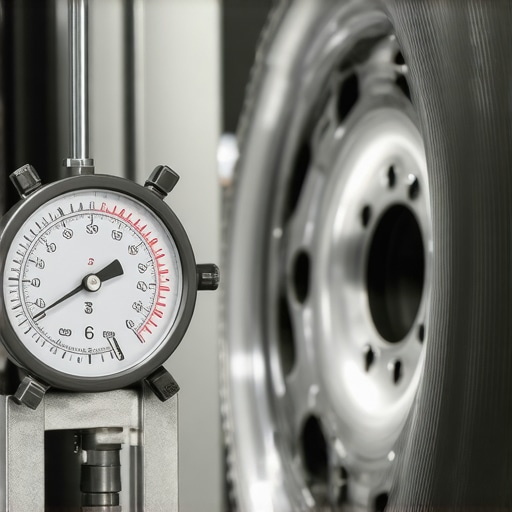
While the previous focus remained on the tire carcass, the wheel flange itself is a common, often overlooked source of structural oscillation. Lateral runout—a side-to-side wobble of the wheel—can mimic the symptoms of a slipped belt but originates from a bent rim or a warped hub face. Unlike a mass imbalance, which a standard auto repair shop can fix with weights, lateral runout requires a dial indicator to measure. If the rim has suffered an impact from a pothole, the metal itself may be out of true. This deviation forces the tire into a zig-zag path, creating a shimmy that feels remarkably like a failing steering rack. Identifying this requires a mechanic to strip the wheel of its tire and measure the bare rim’s runout on a specialized stand.
Is a Bent Rim Different from an Unbalanced Tire?
This question gets to the heart of advanced wheel diagnostics. A bent rim is a geometric defect, whereas an unbalanced tire is a weight distribution defect. You can balance a bent rim by adding counterweights until the machine reads ‘zero,’ but the physical wobble remains. At high speeds, this wobble creates a dynamic force that no amount of lead or zinc can neutralize. According to engineering standards defined by SAE International regarding Noise, Vibration, and Harshness (NVH), even a deviation of 0.030 inches in lateral runout can generate perceptible cabin resonance at highway speeds. If you’ve had your tires balanced multiple times and the shake persists, it is time to stop the cycle of frustration and have a technician perform a runout test on the wheels themselves.
The Hidden Danger of Lug-Centric Mounting
Precision in auto repair often comes down to how a component is centered. Many aftermarket wheels are ‘lug-centric,’ meaning they rely on the tapered lug nuts to center the wheel on the hub, rather than the hub’s center bore itself. If the technician does not use the correct torque sequence or if the hub-centric rings are missing, the wheel may be mounted slightly off-center. This microscopic offset creates a radial runout condition that feels identical to a slipped belt or a flat spot. During a routine tune up, ensuring that your wheel-to-hub interface is clean and correctly shimmed is paramount. A high-quality brake service should also include cleaning the hub face of rust and debris, as even a small flake of corrosion can prevent the wheel from sitting flush, leading to a permanent ‘induced’ vibration that plagues the vehicle regardless of tire health.
Axle Harmonics Mimicking Tire Failure
Sometimes the vibration isn’t coming from the rolling stock at all, but from the components driving them. A failing inner constant velocity (CV) joint can create a rhythmic shudder that is often misdiagnosed as a tire issue. The key differentiator is ‘load sensitivity.’ If the vibration intensifies specifically during hard acceleration and disappears the moment you lift off the throttle, the culprit is likely a pitted CV tulip or a dry tripod joint. This mechanical bind creates a cyclic force that travels through the control arms and into the steering column. While you might be tempted to search for a new set of tires, an experienced mechanic will first check the boots for tears and the axles for excessive play. Have you ever felt a vibration that only appears when you’re climbing a steep grade? This specific nuance is a hallmark of drivetrain-related NVH rather than a structural tire failure. Digging into the specific frequencies of these vibrations can help you isolate the source before you spend money on unnecessary replacements.
Don’t Let Steering Geometry Mask a Simple Wheel Shake
While we often isolate the wheel as a standalone unit, its behavior is inextricably linked to the vehicle’s alignment settings. Excessive ‘toe-out’ can cause a tire to scrub across the pavement rather than roll cleanly, which amplifies any minor internal belt shift into a violent shimmy. A mechanic might spend hours balancing a tire that is technically within spec, only to find that the vibration is actually a feedback loop caused by worn tie-rod ends or incorrect caster angles. During a comprehensive tune up of the steering system, it is vital to realize that alignment doesn’t just affect tire wear; it dictates how the suspension dampens centrifugal forces. If your vehicle feels ‘darty’ while vibrating, the issue isn’t just the rubber—it’s the way the rubber meets the road.
Can a Worn Engine Mount Actually Mimic a Tire Imbalance?
This is a sophisticated diagnostic crossroad. While a tire vibration is speed-dependent, a failing hydraulic engine or transmission mount can create a resonant frequency that perfectly mimics a tire ‘hop’ at specific RPM ranges. If the rubber isolation in a mount has collapsed, the engine’s natural internal harmonics—normally absorbed by the chassis—are transmitted directly into the passenger cabin. This ‘false vibration’ often confuses drivers because it occurs at highway speeds where the engine is under a specific load. According to the technical standards highlighted by The American Society of Body Engineers (ASBE), structural damping is critical; a failed mount turns the entire vehicle into a tuning fork. Distinguishing this from a tire issue requires shifting the transmission into neutral at speed; if the vibration remains, it’s the tires. If it vanishes or changes pitch, look to your mounts or a potential brake service involving the driveline components.
Torque Converter Shudder vs. Radial Runout
Modern multi-speed transmissions utilize a lock-up torque converter to increase efficiency, but when the friction material inside the converter begins to degrade, it produces a sensation often called ‘shudder.’ To the uninitiated, this feels remarkably like driving over rumble strips or having a tire with a slipped belt. However, a mechanic knows that this shudder usually occurs during light-throttle acceleration in high gear. Unlike a tire imbalance, which is persistent, a torque converter issue is transient. Addressing this early during an auto repair session can save the transmission, whereas misdiagnosing it as a tire problem leads to expensive, unnecessary replacements. Proper fluid maintenance is essentially a tune up for your transmission’s ability to dampen these micro-oscillations before they become structural failures.
The Trap of Aftermarket Spacers and Hub Centricity
Enthusiasts often install wheel spacers to achieve a wider stance, but these components are a frequent source of ‘ghost vibrations.’ If a spacer lacks a hub-centric lip, the wheel is supported entirely by the shear strength of the studs. This almost guarantees a minute amount of eccentric runout. Even if you have the best auto repair shop in town, they cannot balance out a wheel that isn’t perfectly centered on the hub. Every 0.1mm of offset translates to a significant centrifugal force at 70 mph. If you’ve recently modified your vehicle and developed a shake, revisit the hardware before blaming the tires or rotors. Have you struggled with a vibration that won’t go away despite multiple balances? Drop a comment below with your vehicle’s modifications, and let’s troubleshoot the harmonic interference together.
Expert Insights & Advanced Considerations
Stop trusting basic balancers for high-speed issues
While a standard spin-balancer addresses mass distribution, it remains blind to tire uniformity. A top-rated mechanic uses Road Force technology to simulate real-world pavement pressure. This is the only way to detect a ‘hard spot’ in the sidewall that acts like a hammer at 70 mph, regardless of how many weights are glued to the rim. If you find your tires are cupping despite regular maintenance, the culprit is often this hidden force variation.
Look for internal heat signatures on suspect tires
Internal belt delamination generates localized friction. After a highway run, a professional can use a thermal imager to spot hot zones on the tread face. These temperature spikes often precede a catastrophic failure, providing a diagnostic window that visual inspection alone misses. This level of scrutiny should be part of any comprehensive ultimate tune-up checklist for vehicles operating in extreme climates.
Check your suspension bushings before blaming the rubber
A tire doesn’t exist in a vacuum; it is part of a complex spring-and-damper system. Worn control arm bushings can allow the wheel to ‘flutter,’ mimicking the symptoms of an out-of-round tire. Before you invest in a new set of tires, ensure your brake service strategies include a thorough inspection of the front-end geometry. Often, the vibration is an amplified resonance of a mechanical clearance that has exceeded its factory spec.
Curated Expert Resources
NHTSA Safety Research: The primary source for tire-related recalls and structural failure data across all major manufacturers. Use this to see if your specific tire model has known casing issues.
SAE International Technical Papers: Deep dives into the physics of vehicle dynamics and tire harmonics, ideal for those who want to understand the mechanical cause behind radial runout.
The Car Care Council: Provides authoritative guides on preventative maintenance that bridge the gap between simple DIY and professional diagnostics.
Final Expert Perspective
Distinguishing between a simple balance issue and a structural belt failure is the hallmark of a truly skilled mechanic. While mass distribution can be fixed with a few grams of lead, a compromised tire carcass is a ticking clock that endangers both your vehicle’s suspension and your safety. Integrating these advanced diagnostic steps into your routine auto repair or tune up schedule ensures that minor shakes don’t evolve into major mechanical disasters. If you are experiencing a vibration that defies standard solutions, look beyond the balancer and investigate the structural integrity of the wheel assembly itself. What is the most frustrating vibration you have ever chased? Share your experience below or contact our team for specialized advice on your next brake service or diagnostic overhaul.